No I'm using an e leaf, checked the connections.
I'm talking about the connection at the 510. You can see what I mean by screwing down the atty far enough to get the right reading and then loosening it slightly. You'll see the ohms jump up by anywhere from .1 to double. Sometimes you'll see the number jumping up and down, too. If it's bad, you will always see this happening.
And yeah, the shop meter... ...not worth it. Cheap vape ohm meters are better because they are designed specifically for checking resistance at the ranges used in vaping. Even the best multimeters have trouble doing what a pocket ohm meter can with reasonable accuracy.
But anywho...
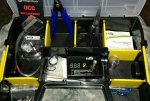
Real simple setup. Not pictured are a Smoktech Omnitester, the basic USA meter, office scissors for wicks, and a Fat Max drill.
The black cylinder is a duracell magnetic screwdriver. It's a better fit than the little blue guys, though I still wind up stripping screws with it sometimes. It does have the ability to switch over to flathead, which comes in handy for 510 pins. The size of the handle gives you the perfect grip and pressure for tightening down thick wire.
Ceramic tweezers for coil squishing and wick-positioning. Being able to squeeze and pulse at the same time makes that step faster and easier... ...plus, your coils come out looking neater when you only have to squish them once. You can't see it in the picture, but both tips have chipped a bit. Fortunately, the tips are replaceable.
Pliers are for pulling parallel leads while they're still on the jig and getting the slack out of springy coils. I also used them to squish and position 22g coils, as the wire is too stiff for ceramic tweezers. That's how I chipped them.
Flush cuts for clipping leads. They're magical. Everyone should own a pair of these. They never pull - they snap any wire right where you put the blades, even fancy alien coils can be cut flush with the post holes with ease.
And finally, the tobeco coil jig. The bag is what I keep the different sized bits in. They range from 1/32 - 9/64. Some people hate these things, but I've become accustomed to them. It's slightly more versatile than the pen coiler and can accommodate any size of drill bit up to a 9/64. It makes wrapping things like flattened parallels, standard parallels, and thick wire a breeze. A lot of times, what I do to get perfect coils is start the first wrap and then pinch the wire on the rod between my finger and thumb, guiding the wire along as I turn the jig itself around the axis of the rod. Works well with delicate and tough builds alike.
Don't really have a need for much else, tbh.