Become a Patron!

So wtf is going on with Claptons?

Iliketurtles

Silver Contributor
Member For 4 Years
Why are claptons so popular and why would you even use one...no really.

Claptonning a core wire/wires allows you to control the ramp up/down time and increases the coil to wick surface area without the need to have a huge number of wraps. It also creates a number of built in vent holes where vapour can escape from every part of the coil - it's gonna drink juice. A normal tight wound coil (commonly termed a micro coil) acts more like a tin can oven, the wires are sealing in the wick and as the wire expands with heat that will get even tighter. By changing the diameter and/or wiretype of the clapton wrap you can alter the heat up/cool down characteristics of the coil. Generally it is accepted that around 8 AWG difference is good (so 26AWG core 34AWG wraps for example). Less difference will make the coil very slow to heat up/cool off, more difference will lessen the coil mass and make hardly any difference to the characteristics of the coil. Many people control this heat flux by using different types of wire for the clapton wrap and the core maybe SS 316 core with a Ka1 wrap - the possibilities are finite :D

So two main things are at play with a claptonned wire 1. The wire surface area for the same number of wraps is increased. 2. The speed at which the wire changes temperature is slowed down. Because you increase the wire to wick contact area this also slows down the heat change speed as the coil is the thing heating the wick so we can assume that the wick is colder than the coil. The overall effect is the coil will stay in a certain temperature range for a longer time, i.e the temperature where you want it to be, the same wire without claptonning will heat up much faster and have less contact area with the wick (juice reservoir) which means it will go from cool to 'too fucking hot' faster....much faster.

You will see people saying that the claptonning increases the wicking properties of the coil - but its fed by essentially the same cotton wick and the coil is wider because of the claptonning so....I think that's mainly nonsense. Maybe if you were using the coil without a wick in it then it would be relevant but who does that? On top of the wick thing the coil cools down slower, so it continues to vaporise juice while you have no power going into it - so any perceived advantage of wicking due to capillary action is negated by the fact it is vaporising the juice even when its not powered. You can believe either way that you like, I doubt that any scientific research is gonna prove one or the other at any time soon.

You will also see many people say that the pre-made clapton wire which is now coming out of china is garbage...on that I have to agree. I mean it is kinda OK but they should up their game, what I have seen is usually 26Ka1 claptonned with 32 Ka1 - most builders would not do that combination out of choice. But if you like it you would ha ha - if you get some of that stuff you likely want to either build low with it or put it on a regulated mod and up the volts.

So what is better - a fused clapton or parallel clapton coils?
Only joking, it's always down to you and what you like. Luckily for me I like most things...depends which day it is :)
 

JERUS

Gold Contributor
Member For 4 Years
Member For 3 Years
Member For 2 Years
Member For 1 Year
I've contemplated this myself, to the point that I've wrapped quite a few parallel coils to consider the difference. I can honestly say with a high gauge wrap (40g) I can tell the difference, and the negatives (ramp up) is negligible. As far as wicking properties, they're visible, just look at the coils. You can see the juice build up in a clapton coil .

As far as the science, I don't think single wire claptons are worth it, my experience and the logic seem to concur. Claptons act as a heat sink, drawing the heat from the core and transfering it to the outside. Heat dissipation is a field, if you have a circular object it's a circular field, well go with a fused clapton and you have increased the horizontal axis of both the wire and the heat dissipation field. This means less fields and less vacant space as the field increases. + + + + + is your typical coil, even without spaces, as that field dissipates its' + + + + + growing further apart until the various fields connect. It's not even heating at the center of the wick basically. Now, compare it to a fused clapton that's tightly wound with high gauge wire an its' ++ ++ ++ dissipating into ++ ++ ++, less vacant space is going to happen before it connects with the other sources of heat.

I think there are certainly scientific reasons for claptons, I don't believe strait claptons are worthwhile as they don't really promote the even heat the way a fused clapton would, and my experience says a parallel coil is better than a single core clapton, but fused claptons, I think not only make sense on the logical side but also the experience side. Now, why alien wire is superior, well I haven't got a clue but my experience tells me it is. Functionally effective enough for the effort, IMO no, but I can say that the alien coil I ordered is superior to the fused clapton of similar specs. Maybe it's the 3 core thing allowing more juice to flow inside the coil to the cores, but anyways it's better.

From my personal experience, I'd always suggest just twisting some wire over premade claptons, not worth the ramp up to pay the additional price that as far as I'm concerned is a worse vape (I haven't bought the stuff but I've made my own 32g claptons that sucked). As far as higher gauge single core claptons yes it's better, but not worth the effort, especially considering how simple of a jump it is to fused claptons from there which IMO is the biggest jump in vape quality that I've experienced.

Anyways, my 2cents on the matter.
 

robot zombie

Silver Contributor
Member For 4 Years
Very nice, simple explanation of how claptons work and why people use them.

I will disagree with you now and forever on wicking, though. :p

I don't think it's incorrect to point out that a coil can only wick as quickly as the cotton can bring it to the surface. I think it would be silly to assume that claptons somehow wick faster than standard coils. That's physically impossible.

However, I've always assumed that claptons improve wicking not by moving juice faster, but by decreasing the wicking demands of the coil. If we are to assume that juice travels more slowly through the coil (which I think is reasonable - you can observe this by dropping juice onto saturated cotton while simultaneously dropping some on a wet coil to see the difference in absorption,) then the coils will always be holding onto some juice even as more travels up through the wicks.

And then there's juice dispersal to think about. A standard coil has a smooth, wide outer surface. When a sufficiently cooler liquid hits a smooth and wide heated surface, it scatters rapidly - and wherever it scatters from is going to be hotter than where it scatters to. Not only that, but those points are going to heat-up faster than where it's running to. It's constantly pushing juice away from its hottest points, which makes them increasingly hotter. With the semi-porous surface of claptons, the juice is not scattered as easily. It's just getting pushed through all of the little pockets. I would liken it to difference between a drop of water on a hot pan and a drop of water on a similarly hot road.

The center of the coil is going to be the hottest point, meaning juice is going to be more powerfully repelled from the center. With a clapton, it has to overcome this network of channels in order to travel away from the center, whereas with a standard coil, it simply has to push across long gradual inclines.

Because of this (I think!) a clapton maintains better juice coverage and thus the temperature of the coil is more consistent, which again, decreases wicking demands, as more of the surface is liable to have juice on it at any point in time. It's a feedback loop of self-regulating thermal-liquid reactions. It's not just a matter of how the heat dissipates, but also where the juice is going and how this affects heat dissipation.

You also mentioned heat retention. That is going to depend exclusively on the mass of the coils and the power level. A clapton doesn't hold onto any more heat than a standard coil of equivalent mass would, which means that it wouldn't vaporize any more juice while standing than its standard brethren would. And even when they do fizzle, it's got to be a tiny fraction of what you go through in a single hit. It's not like vapor continues flying off of them. And if it does, then that's not a very good clapton build! :p I'm not seeing how that could completely negate any wicking pluses they might have.

That's just my hypothesis. One thing I am sure of is that it is difficult for me to believe that there's nothing going on aside from the increased outer diameter, the heat sink and that little buffer. With enough power, it makes all of the difference between dry hit and smooth hit. A bigger, hotter clapton will always out-wick a smaller, less-hot standard coil. Can't help but wonder why that is. If we assume that there's no change in wicking one way or the other, then a coil of a larger mass and higher temperature shouldn't wick better!

All that said, I can't pretend to understand it, but the physics and logic are there somewhere. Claptons are demonstrably easier on wicks and there have to be reasons for that.


I don't believe strait claptons are worthwhile as they don't really promote the even heat the way a fused clapton would, and my experience says a parallel coil is better than a single core clapton, but fused claptons, I think not only make sense on the logical side but also the experience side. Now, why alien wire is superior, well I haven't got a clue but my experience tells me it is. Functionally effective enough for the effort, IMO no, but I can say that the alien coil I ordered is superior to the fused clapton of similar specs. Maybe it's the 3 core thing allowing more juice to flow inside the coil to the cores, but anyways it's better.
I think it's the valleys. Juice is collecting in them. Having the juice collect in those larger crevices probably detracts more from the scattering effect I wrote of before.

I think single-cores have their merits. Multi-cores obviously do what they do better, but singles can still be more beneficial, depending on size and airflow constraints. A single-core clapton in a smaller RDA can be made to perform similarly to a fused clapton in a large RDA. For instance, in most RDA's, I use fused claptons, but in something tiny like my snubnose, I would use smaller single-cores. Vapor production is lower of course, but flavor, temperature, and wicking are comparable.


Excuse the gobbledygook, but you can't not have seen it coming. ;)
 
Last edited:

Iliketurtles

Silver Contributor
Member For 4 Years
Discussion is good, I often see/hear people asking why a clapton would be better they don't understand in any way what could be different with a bit of thinner wire wrapped round. So I thought that a thread on that very subject would be nice. We can disagree on stuff, it's allowed....I have a feeling it may even be compulsory :D
 

JERUS

Gold Contributor
Member For 4 Years
Member For 3 Years
Member For 2 Years
Member For 1 Year
Very nice, simple explanation of how claptons work and why people use them.

I will disagree with you now and forever on wicking, though. :p

I don't think it's incorrect to point out that a coil can only wick as quickly as the cotton can bring it to the surface. I think it would be silly to assume that claptons somehow wick faster than standard coils. That's physically impossible.

However, I've always assumed that claptons improve wicking not by moving juice faster, but by decreasing the wicking demands of the coil. If we are to assume that juice travels more slowly through the coil (which I think is reasonable - you can observe this by dropping juice onto saturated cotton while simultaneously dropping some on a wet coil to see the difference in absorption,) then the coils will always be holding onto some juice even as more travels up through the wicks.

And then there's juice dispersal to think about. A standard coil has a smooth, wide outer surface. When a sufficiently cooler liquid hits a smooth and wide heated surface, it scatters rapidly - and wherever it scatters from is going to be hotter than where it scatters to. Not only that, but those points are going to heat-up faster than where it's running too. It's constantly pushing juice away from its hottest points, which makes them increasingly hotter. With the semi-porous surface of claptons, the juice is not scattered as easily. It's just getting pushed through all of the little pockets. I would liken it to difference between a drop of water on a hot pan and a drop of water on a similarly hot road.

The center of the coil is going to be the hottest point, meaning juice is going to be more powerfully repelled from the center. With a clapton, it has to overcome this network of channels in order to travel away from the center, whereas with a standard coil, it simply has to push across long gradual inclines.

Because of this (I think!) a clapton maintains better juice coverage and thus the temperature of the coil is more consistent, which again, decreases wicking demands, as more of the surface is liable to have juice on it at any point in time. It's a feedback loop of self-regulating thermal-liquid reactions. It's not just a matter of how the heat dissipates, but also where the juice is going and how this affects heat dissipation.

You also mentioned heat retention. That is going to depend exclusively on the mass of the coils and the power level. A clapton doesn't hold onto any more heat than a standard coil of equivalent mass would, which means that it wouldn't vaporize any more juice while standing than its standard brethren would. And even when they do fizzle, it's got to be a tiny fraction of what you go through in a single hit. It's not like vapor continues flying off of them. And if it does, then that's not a very good clapton build! :p I'm not seeing how that could completely negate any wicking pluses they might have.

That's just my hypothesis. One thing I am sure of is that it is difficult for me to believe that there's nothing going on aside from the increased outer diameter, the heat sink and that little buffer. With enough power, it makes all of the difference between dry hit and smooth hit. A bigger, hotter clapton will always out-wick a smaller, less-hot standard coil. Can't help but wonder why that is. If we assume that there's no change in wicking one way or the other, then a coil of a larger mass and higher temperature shouldn't wick better!

All that said, I can't pretend to understand it, but the physics and logic are there somewhere. Claptons are demonstrably easier on wicks and there have to be reason for that.


I think it's the valleys. Juice is collecting in them. Having the juice collect in those larger crevices probably detracts more from the scattering effect I wrote of before.

I think single-cores have their merits. Multi-cores obviously do what they do better, but singles can still be more beneficial, depending on size and airflow constraints. A single-core clapton in a smaller RDA can be made to perform similarly to a fused clapton in a large RDA. For instance, in most RDA's, I use fused claptons, but in something tiny like my snubnose, I would use smaller single-cores. Vapor production is lower of course, but flavor, temperature, and wicking are comparable.


Excuse the gobbledygook, but you can't not have seen it coming. ;)
Didn't mean to say faster wicking, but simply that the wire itself can hold some juice, so the wire will pull more juice if given the time to do so. Anyways, well said :)
 

Iliketurtles

Silver Contributor
Member For 4 Years
I dont think single wire claptons are a waste of time at all. SS wire claptonned with Ni80 or kanthal is a great combination. SS wire has some cool properties in that it can be used with power mode but the resistance increases as it heats up...it naturally draws less power when set on a mech mod or VV regulated as it heats up, combine that with some wire wraps and you have a nice coil that stays 'in the zone' as you vape it.
 

JERUS

Gold Contributor
Member For 4 Years
Member For 3 Years
Member For 2 Years
Member For 1 Year
I dont think single wire claptons are a waste of time at all. SS wire claptonned with Ni80 or kanthal is a great combination. SS wire has some cool properties in that it can be used with power mode but the resistance increases as it heats up...it naturally draws less power when set on a mech mod or VV regulated as it heats up, combine that with some wire wraps and you have a nice coil that stays 'in the zone' as you vape it.
It's not that I think they're bad, it's just that I don't think the benefits are enough to warrant the time spent, I'd rather jump to fused claptons. I haven't tried a single core with SS yet though, I've done fused which was pretty nice, I'll have to give it a shot.
 

martnargh

Silver Contributor
Member For 4 Years
Member For 3 Years
For real, i dont have 2 hrs to read this novel, lol

Sent from my SM-N920T using Tapatalk
 

JERUS

Gold Contributor
Member For 4 Years
Member For 3 Years
Member For 2 Years
Member For 1 Year
Cliffs notes?
Claptons do have wicking properties, and it will heat the juice in a more unique way that makes it worthwhile. That pretty much sums it up without any detail :wait:
 

Devilon

Member For 4 Years
ECF Refugee
For the heck of it I ordered some from 32/26 KA1 claptons from FT, I wasn't hoping for much but I bundled some into the Boreas tank and they are working a treat.
And I was surprised how clean the wire was when it arrived, although I still gave it a good burn before fitting them in.
 

Iliketurtles

Silver Contributor
Member For 4 Years
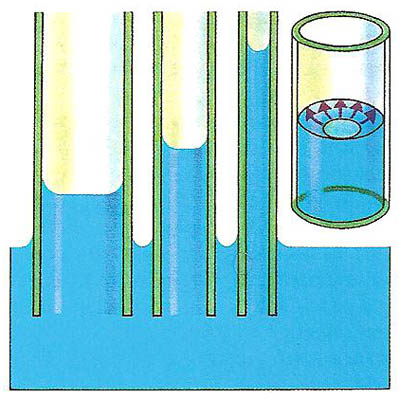
Capillary action...he he, its a byproduct of surface tension. A fluid will 'lift' itself between boundaries depending on the surface tension between the boudaries..if the tension is less than the weight of fluid between the bounds it raises less. i.e.

capillarity.jpg


The closer the bounds the better it works, so maybe tighter wicks actually wick better, at least as long as there is room between the fibres for the liquid to travel.
 

VU Sponsors

Top