
Hi i started vaping just over a week again and all was fine when i was doing mouth to lung hits but then i started to do straight to lung hits and even since then i keep getting a burning feeling in my throat every time i do it and i really want to know why and how to stop it my vapers friends think it's the juice i am using that it's not meant for higher wattage i was on 80 watts with my smok alien with my baby beast tank with a t8 coil but i had to turn it down to 50 it helped abit not it is still doing it but only on a lung hit so hoping some one on here could maybe help out and tell me if it is the juice that's doing it or something else also the coil has been replaced and it still done it.

Become a Patron!
You are using an out of date browser. It may not display this or other websites correctly.
You should upgrade or use an alternative browser.
You should upgrade or use an alternative browser.
Burning Throat On Lung Hit
- Thread starter EpLegendz
- Start date


When I first started vaping before I totally quit and for weeks after, it irritated my throat and made me cough. I attribute it to that lack of chemicals in cigarettes that act as a sort of anesthesia in your throat and lungs. Remember though I am not a doctor and do not play one on the Internet so it is just my opinion but there is some factual evidence to back up what my opinion is.

A T8 coil is way too strong for a beginning vaper. It has an ohm reading of 0.15. That's gonna give you too hot a vape. Try coils that ohm out at 0.5 and above.
A T8 coil is way too strong for a beginning vaper. It has an ohm reading of 0.15. That's gonna give you too hot a vape. Try coils that ohm out at 0.5 and above.
Can you please explain ohms to me please is 0.15 lower or higher then 0.5 because you said try out a 0.5 ohms or higher but surly 0.15 is higher then 0.5????

Ohms is a unit of measure for electrical resistance. Resistance measures how much your coil is "resisting" the current that is passing through it. The lower the resistance, the greater the current that is running through the coil. The greater the current, the more stress you put through your batteries.
Current is a measure of how much electricity is flowing through a circuit. Your batteries transfer current through a circuit to the coil. However, batteries are only rated to be able to transfer so much current. That rating is printed on the battery most of the time (but not always.) If you go beyond that rating, the battery will fail. This is bad because when a battery fails, the heat created by the current causes internal pressure to build to the point where the battery cell gives way, sending superheated gases, sparks and fire shooting through the air. Your battery effectively turns into a rocket. Now remember, you are using batteries that have Lithium cells. Lithium is an alkali metal, and alkali metals react violently when they mix with water vapor in the air. This is what causes injuries to vapers. A venting battery is almost always caused by vapers running too much current through the battery. Batteries can vent in other ways as well, such as manufacturer flaws, but that is incredibly rare.
This video shows a battery vent in action. This is what happens when you go too high on current.
And this is why we have Ohm's Law. Ohm's Law describes the relationship between four things: current, resistance, voltage and power. Basically, if we know two of those pieces of information, we can use these mathematical formulas to determine the remaining two. This table shows how you can use Ohm's Law to calculate current, power, voltage and resistance in a specific build. As long as you use it to stay within the battery's safe operating range, you will not vent your batteries. This table should become your Bible as a vaper.
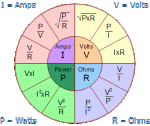
Here is an example of Ohm's Law in action.
Let's say you have a .32-ohm coil, and you're running it at 120 watts on a battery rated for 25 amps. You want to know if your build is safe. To determine this, we consult the table above. According to the table, we can use the power and the resistance to determine the current. The mathematical formula for this is:
I = √P/R
This means that to find the current, we can divide 120, the power, by .32, the resistance, and squareroot the quotient.
120 / .3 = 375
√ 375 = ~19.36 amps
So in a build with a .32-ohm coil running at 120 watts, we are pulling about 19.36 amps through the batteries. This is within the safe operating range of the battery.
Now let's get a bit more dangerous. Let's say we have a .13-ohm coil and we're running it at 130 watts.
130 / .13 = 1,000
√ 1,000 = ~31.62 amps
DO NOT run this build. This build would go beyond the safe operating range of the battery, and would eventually cause your battery to vent.
Now let's pretend we have a .13-ohm coil, but we don't know the power. However, we have a voltage of 4.3 volts. We will use a different calculation here. Again, we consult the Ohm's Law table, and we find that we can divide the voltage by the resistance to get the current.
4.3 / .13 = ~33.07 amps
Again, we have gone beyond the safe operating range of the battery, and should never run a build like this on a 25-amp battery.
See there? It's pretty simple once you get used to it.
At this point, I feel it's important to discuss the difference between regulated and non-regulated mods.
A regulated mod will have a small computer chip that's designed to automatically cut power to the circuit when you go beyond a specific threshold. Non-regulated mods (often called mech mods) do not have this protection. These are the mods that cause batteries to vent. Since you don't seem to know much about vaping and Ohm's Law (otherwise you wouldn't have asked your question about resistance), I strongly suggest you use a regulated device. Most boxes are regulated, but there are unregulated boxes as well. Pay attention to the packaging. It will usually say if a box is regulated or not. If it doesn't say on the package, you can check the manual, ask the employee at your vape shop (most vape shops don't want to be responsible for a beginning vaper that ends up hurting themselves badly) or look it up online.
Also, a word of warning: You can still cause your batteries to vent on a regulated device. You just *really* have to fuck up to do it.
Current is a measure of how much electricity is flowing through a circuit. Your batteries transfer current through a circuit to the coil. However, batteries are only rated to be able to transfer so much current. That rating is printed on the battery most of the time (but not always.) If you go beyond that rating, the battery will fail. This is bad because when a battery fails, the heat created by the current causes internal pressure to build to the point where the battery cell gives way, sending superheated gases, sparks and fire shooting through the air. Your battery effectively turns into a rocket. Now remember, you are using batteries that have Lithium cells. Lithium is an alkali metal, and alkali metals react violently when they mix with water vapor in the air. This is what causes injuries to vapers. A venting battery is almost always caused by vapers running too much current through the battery. Batteries can vent in other ways as well, such as manufacturer flaws, but that is incredibly rare.
This video shows a battery vent in action. This is what happens when you go too high on current.
And this is why we have Ohm's Law. Ohm's Law describes the relationship between four things: current, resistance, voltage and power. Basically, if we know two of those pieces of information, we can use these mathematical formulas to determine the remaining two. This table shows how you can use Ohm's Law to calculate current, power, voltage and resistance in a specific build. As long as you use it to stay within the battery's safe operating range, you will not vent your batteries. This table should become your Bible as a vaper.
Here is an example of Ohm's Law in action.
Let's say you have a .32-ohm coil, and you're running it at 120 watts on a battery rated for 25 amps. You want to know if your build is safe. To determine this, we consult the table above. According to the table, we can use the power and the resistance to determine the current. The mathematical formula for this is:
I = √P/R
This means that to find the current, we can divide 120, the power, by .32, the resistance, and squareroot the quotient.
120 / .3 = 375
√ 375 = ~19.36 amps
So in a build with a .32-ohm coil running at 120 watts, we are pulling about 19.36 amps through the batteries. This is within the safe operating range of the battery.
Now let's get a bit more dangerous. Let's say we have a .13-ohm coil and we're running it at 130 watts.
130 / .13 = 1,000
√ 1,000 = ~31.62 amps
DO NOT run this build. This build would go beyond the safe operating range of the battery, and would eventually cause your battery to vent.
Now let's pretend we have a .13-ohm coil, but we don't know the power. However, we have a voltage of 4.3 volts. We will use a different calculation here. Again, we consult the Ohm's Law table, and we find that we can divide the voltage by the resistance to get the current.
4.3 / .13 = ~33.07 amps
Again, we have gone beyond the safe operating range of the battery, and should never run a build like this on a 25-amp battery.
See there? It's pretty simple once you get used to it.
At this point, I feel it's important to discuss the difference between regulated and non-regulated mods.
A regulated mod will have a small computer chip that's designed to automatically cut power to the circuit when you go beyond a specific threshold. Non-regulated mods (often called mech mods) do not have this protection. These are the mods that cause batteries to vent. Since you don't seem to know much about vaping and Ohm's Law (otherwise you wouldn't have asked your question about resistance), I strongly suggest you use a regulated device. Most boxes are regulated, but there are unregulated boxes as well. Pay attention to the packaging. It will usually say if a box is regulated or not. If it doesn't say on the package, you can check the manual, ask the employee at your vape shop (most vape shops don't want to be responsible for a beginning vaper that ends up hurting themselves badly) or look it up online.
Also, a word of warning: You can still cause your batteries to vent on a regulated device. You just *really* have to fuck up to do it.
Last edited:

vapemesilly
Member For 4 Years
You can also try turn down the wattage some more.