
I'm not an electrician or electrical engineer but, can any regulated mod truly put out 200 watts using dual 18650's ?
Last edited:


Nope, they use PWM.I'm not an electrician or electrical engineer but, can any mod truly put out 200 watts using dual 18650's ?
Oops sorry, I thought OP meant regulated like the snow wolf 200w.
Sent from my SM-N920T using Tapatalk
What's the question?I'm not an electrician or electrical engineer but, can any mod truly put out 200 watts using dual 18650's ?


thank you!The answer to your question is yes. Yes, they absolutely can. If you are asking if they can provide that level of output with out exceeding the batteries specifications. Well, that is debatable. 200 W output requires a higher input due to the efficiency of the circuit board. If you assume a 95% efficiency it would be an input of 210.5 W. The exact equation to calculate the safety would be battery utilized and mod dependent. You would have to know the low voltage cut off of the device and have detailed battery specifications.
For example:
If we use a low voltage cut off of 6.6 V, 210.5 W would require a current drain on the batteries of 31.9 A. Despite what independent tests and charts from data sheets taken out of context might suggest, that is a higher discharge rate than any manufacturer data sheet of 18650 cells specifies.
In other words, if you are utilizing a quality battery with a 30 A CDR you would be exceeding the manufacturers specifications at 200 W by 6.3%. Is it possible? Yes. Should you do it? That is entirely up to you.
Your welcome. And thanks for the inclusion of a recherche adjective in your post. I can count on my index finger how many times I have seen cogent used on an internet forum.Thanks for that very cogent answer

Don't mods like the snow wolf or any 2 cell mods use PWM?The answer to your question is yes. Yes, they absolutely can. If you are asking if they can provide that level of output with out exceeding the batteries specifications. Well, that is debatable. 200 W output requires a higher input due to the efficiency of the circuit board. If you assume a 95% efficiency it would be an input of 210.5 W. The exact equation to calculate the safety would be battery utilized and mod dependent. You would have to know the low voltage cut off of the device and have detailed battery specifications.
For example:
If we use a low voltage cut off of 6.6 V, 210.5 W would require a current drain on the batteries of 31.9 A. Despite what independent tests and charts from data sheets taken out of context might suggest, that is a higher discharge rate than any manufacturer data sheet of 18650 cells specifies.
In other words, if you are utilizing a quality battery with a 30 A CDR you would be exceeding the manufacturers specifications at 200 W by 6.3%. Is it possible? Yes. Should you do it? That is entirely up to you.
Nope, they use PWM.
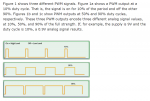
Thanks for clearing that up, really concise and exactly what I asked. Many thanks to you sirPower is not determined by the signal type regardless if it's PWM, PFM, Sawtooth, Sine etc.. while the power output can be affected by the signal type, Power (P) is determined by Amps (I) & Volts (V) (P= I*V).
The use of PWM does not boost power in our uses it reduces it by reducing the time the signal is at an active high called the Duty Cycle. If a 10V signal has a duty cycle of 100% it's 10V essentially flat DC. If the same 10V signal has a duty cycle of 50% it's 5V, on half the time and off the other half. By increasing the amount time the signal is low they can easily and cheaply regulate and lower the output but can never increase it more than 100% duty cycle. That being said if a device is advertised for a specific power output it should be able to achieve that output regardless of signal type using P=I*V. Here's an image and link for more info on PWM.
http://www.embedded.com/electronics...023833/Introduction-to-Pulse-Width-Modulation
View attachment 44595
Another pet peeve of mine is I often see someone say (oh it's PWM it rattle snakes) or similar. That's not entirely true either, what we hear isn't that it's PWM but the Frequency (Hz) that it's switching at. If the frequency is low we'll here it turning the signal on and off but if the frequency is high it will sound constant to us. Kind of like how we don't see our lights flickering although the signal is oscillating at 60Hz for us here in the states.
Here's a tone generator you can use to see an example of what I'm saying. Decrease the frequency and you can hear it switching, increase it and it will become a constant tone. The signal type hasn't changed only it's frequency. Try a square wave at 10Hz and you'll definitely pickup the clicking sounds of the signal going high to low. Then try it at 50Hz, it's now a constant sound so we cant really hear the signal going high to low any longer. Same square wave just a different frequency.
http://onlinetonegenerator.com/


