

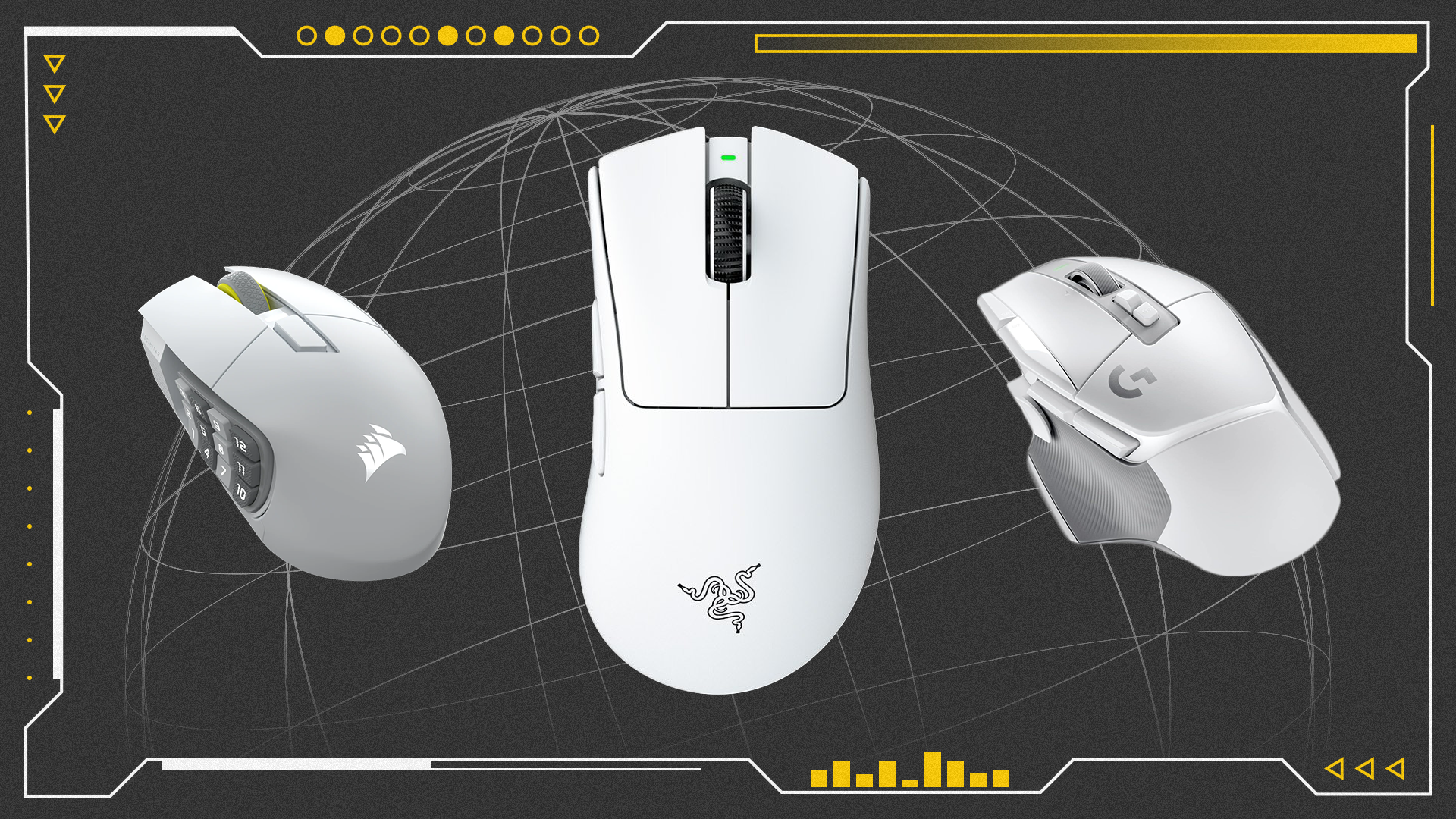
When it comes to gaming mice, the choices are almost endless. Unlike grabbing a headset where the best pick is usually clearer, picking a mouse often comes down to what feels right in your hand. Sure, some models are flat-out better thanks to things like build quality or performance, but it really depends on whether you care more about weight, grip, button placement, or even the kind of games you sink your time into. With that in mind, I’ve sorted my top recommendations into neat categories so you can zero in on the mouse that suits you best.
Enough preamble, though. Let's get into the guide, so I can run through my hands-on time with each option and explain why they shine in their chosen lane.
TL;DR – These Are the Best Gaming Mice
This guide contains contributions by Michael Higham, Danielle Abraham and Samuel Horti.
1. Razer Deathadder V4 Pro
Best Overall Gaming Mouse
The Deathadder has been a fixture at the top of gaming mouse rankings for years, and the V4 Pro shows why. Razer has fine-tuned everything from the sensor to the scrollwheel. The upgrades may seem small in isolation, but together they make a serious impact.
It's lightweight, comfortable, and built to last, with a refreshingly understated design. No gaudy RGB, no oversized branding; just high-end specs worth showing off. A 45K sensor and 8K polling rate may be excessive, but they're the sort of overkill that ensures this mouse can stay in service for years while the rest of your setup changes and evovles around it.
Performance is rock solid, with flawless tracking and lightning-fast response on both the primary and side buttons. Long gaming sessions are handled with ease regardless of grip style. Even the USB dongle is thoughtfully designed, with three handy indicator lights. Battery life is another standout, clocking in at up to 150 hours at 1K polling rate - more than enough for marathon sessions.
Yes, it does sit at the premium end of the market, but the feature set and polish justify its place. It'll take something truly special to knock this one off its throne.
2. SteelSeries Rival 3
Best Budget Gaming Mouse
If your wallet is running on fumes but you still need a solid step up from an office clicker, the SteelSeries Rival 3 is hard to beat for the price. At just 77g, this wired, symmetrical little unit feels nimble in the hand, especially for fingertip and claw grip players. It throws in a bit of flair too, with RGB lighting along the base and the glowing SteelSeries logo. More importantly, it handles with enough accuracy that I’ve happily trusted it in sweaty Counter-Strike 2 matches without hesitation.
Yeah, look, its sensor maxes out at 8,500 DPI, but the TrueMove optical tech keeps things precise. The main clicks aren’t as satisfyingly crunchy as premium rivals, and the slim side buttons take some getting used to, yet it still holds up under fire. It’s a jack-of-all-trades design that may not hug every hand perfectly, but for this price, the Rival 3 is a bargain.
3. SteelSeries Aerox 3 Wireless
Best Budget Wireless Gaming Mouse
The SteelSeries Aerox 3 is the definition of showy, with its honeycomb-style shell and rainbow RGB bleeding through every cutout. At first glance it looks like a dust magnet waiting to happen, but the internals are sealed off so there’s no real risk. The lighting is customisable in SteelSeries’ software, and while the design screams gamer, it’s surprisingly practical once you start playing. Best of all, it’s a wireless unit that often dips into bargain territory during sales, which makes it a rare mix of flashy and affordable.
Performance-wise, the Aerox 3 punches above its weight. The TrueMove Air sensor offers excellent precision up to 18,000 DPI, and while its battery life isn’t record-breaking by today’s standards, it’s still solid and tops up quickly when needed. It’s nimble, comfortable, and dependable in shooters, all while looking like a party on your desk. For a budget-friendly wireless mouse, it’s a standout.
4. Logitech G403 Hero
Best Wired Gaming Mouse
Logitech’s G403 has long been my go-to when I don’t feel like chasing the latest shiny toy. To me, it carries the spirit of the old MX 518, which was my ride-or-die back in the day. The slightly bulkier frame works a treat for bigger hands, and the rubberised sides make it easy to lift and flick with confidence. It does pick up grime quicker than smoother shells, but the trade-off in grip is worth it. Palm grippers will love the size, though folks after something smaller might find it a bit of a handful.
What keeps me coming back are those chunky side buttons. They’re clicky, distinct, and perfectly placed, which makes mapping key actions dead simple in-game. Under the hood, you’re still getting Logitech’s Hero sensor, the same kit powering its premium lineup, which makes the value here hard to ignore. Add in clean looks with subtle RGB, and it’s a classic..
5. Logitech G703 Hero
Best Wireless Gaming Mouse
The Logitech G703 has always struck me as the natural evolution of the G403, only this time you cut the cord. Shape-wise it’s practically identical, though the built-in battery bumps the weight up to about 95g. Even with the extra heft, it doesn’t feel sluggish thanks to smart balance across the body. What you end up with is the same tried-and-true comfort, only now with the freedom of wireless.
I’ve always liked how secure it feels in hand, with the rubberised grips taking some of the strain when lifting or swiping mid-match. Palm grip players in particular will appreciate the larger frame, though it might be too chunky for those chasing ultra-light builds. Performance-wise, the Hero 25K sensor keeps things sharp and responsive, putting it on par with Logitech’s higher-end models. If you want that familiar G403 feel but without the leash, the G703 is the obvious choice.
6. Corsair Scimitar Elite
Best MMO/MOBA Gaming Mouse
Corsair’s Scimitar Elite is still my benchmark for multi-button mice. Packing 12 thumb-side buttons sounds like overkill, but the layout is surprisingly usable. Each column has its own texture, so you can feel your way around without looking, and the buttons have just the right amount of resistance to avoid misclicks.
It’s a hefty unit, sure, but this isn’t meant for twitchy shooters. Where it shines is in MMOs, MOBAs, or even creative work, where all those programmable inputs save serious time. If you’re in the market for a mouse with extra real estate for shortcuts, the Scimitar Elite remains tough to beat.
7. Turtle Beach Pure Air
Most Versatile Gaming Mouse
Turtle Beach mice can be hit-or-miss, but the Pure Air is a clear winner. It’s light, comfortable, and pairs long battery life with Bluetooth, making it just as handy for work as it is for play. The thumb groove gives it a snug feel, and its smaller frame is easy to handle when desk space is tight.
I put it through its paces in Helldivers II and found it more than capable of keeping up during chaotic firefights. The only real gripe is with the side buttons, which are a bit too slim and lack clear separation. Still, for travel or hybrid use, it’s hard to beat. Bluetooth makes it a versatile daily driver, while the 2.4 GHz dongle delivers low-latency performance when it’s time to focus on gaming at home.
8. HyperX Pulsefire Haste 2 Mini
Best Small Gaming Mouse
Finding a gaming mouse that nails the "compact but capable" brief is trickier than you'd think, which is why the HyperX Pulsefire Haste 2 Mini grabs the spotlight. The full-sized Haste 2 was already a gem in its own right (and yes, I weirdly liked its chunkier frame), but slicing it down to a tidier size turns out to be more than a gimmick. The Mini keeps its sharp looks, tosses in a splash of RGB, and wraps it all up in a textured shell that's perfect for fingertip control. With the shorter height and trimmed-down length, it feels nimble in hand without losing its punch.
If you've ever tried to wrangle something hefty like the Logitech G703 or Razer Viper V3 Pro with smaller hands, you'll know the struggle. The Pulsefire Haste 2 Mini fixes that without forcing you to give up the performance essentials. Sure, there are tinier and lighter mice floating around, but HyperX managed to squeeze in its Precision 26K sensor and a battery that goes the distance. Add Bluetooth into the mix and you've got a pocket-friendly option that pulls double duty for gaming and work alike. In short, it's more than just a downsized sibling - it's a cheeky little all-rounder that can hold its own.
9. Asus ROG Keris II Ace
Best Lightweight Gaming Mouse
The Asus ROG Keris II Ace might clock in at a weight similar to other lightweight contenders, but the real trick is how evenly that weight is spread. Swapping back and forth with the DeathAdder V3 HyperSpeed confirmed it for me - the Keris feels just a touch more natural. Its right-handed sculpt makes it sit snug in the palm, while still letting claw grippers get comfy.
Specs-wise, it doesn’t muck about. The AimPoint Pro sensor tops out at 42,000 DPI, and the polling rate can shoot up to 8000 Hz. You’ll only notice gains from that kind of speed with serious hardware pushing high refresh and high frames, but under those conditions the tracking is buttery smooth. The surface texture is a bit slick and the clicks feel softer than I’d like, yet despite those quirks it’s still one of the strongest performers in the lightweight camp.
10. Logitech G502 X Lightspeed
Best Ergonomic Gaming Mouse
If you’re chasing pure ergonomics, gaming mice usually aren’t the answer – upright or trackball designs do that best. Still, the Logitech G502 strikes a sweet middle ground between comfort and performance. Its wide base and deep thumb groove give you a steady grip and a natural resting spot, while the extra five side buttons (three thumb-accessible, two beside left click) add heaps of flexibility for both games and productivity.
This isn’t the mouse you’ll be whipping around in sweaty Battlefield 6 matches. The weight and bulk make it less nimble than a Razer Viper V3 Pro or HyperX Pulsefire Haste 2 Mini. But with Logitech’s Hero 25K sensor onboard, accuracy and responsiveness are never an issue. As long as you’re not chasing pinpoint flick shots, the G502 delivers reliable performance while being one of the comfiest mice you can buy.
Gaming Mouse FAQ
How do you determine what makes a good gaming mouse?
Figuring out what makes a gaming mouse good isn’t as clear-cut as it sounds. A lot of it boils down to personal preference and what you need it to do. I wouldn’t suggest the Viper V3 Pro to someone after a compact all-rounder, but for someone grinding Valorant ladders it’s spot on. Over years of testing mice, I’ve picked up on the subtle differences between models and how those details shape the overall experience.
The first thing to lock in is your grip style: palm, claw, or fingertip. Bigger mice usually suit palm grips, while smaller, lighter ones are better for fingertip. If you like deep grooves to rest your thumb and pinky, an ergonomic model will feel best. If you care more about speed and flicking, a featherweight mouse is the way to go. Some shapes are symmetrical and lefty-friendly, while right-handed builds hug the hand more naturally.
Click feel is another factor. Switches vary a lot, and while some are squishy, others are crisp and tactile. The latter are generally better for quick firing in shooters or heavy clicking in MOBAs. Side buttons deserve attention too. Two is standard, but their shape and placement can make or break usability. Models like the Logitech G502 or Corsair Scimitar Elite add extra buttons for productivity or MMO play, though they sacrifice a bit of speed.
Then there’s the sensor. Pretty much every modern gaming mouse has an excellent optical sensor, so tracking accuracy isn’t the worry it once was. High DPI numbers sound impressive, but past a certain point it’s marketing fluff rather than a practical advantage.
What’s the deal with high polling rate on gaming mice?
Most gaming mice these days ship with a 1000 Hz polling rate, meaning they send updates to your PC every single millisecond. For the average player, that’s already lightning fast. Lately though, esports has pushed a new trend: ultra-high polling rates that go all the way up to 8000 Hz. Top-end models like the Razer Viper V3 Pro and Asus Keris II Ace let you switch between 1000, 2000, 4000, and 8000 Hz. It’s a neat technical leap, but the benefits only show up in certain scenarios.
Polling Rate | Response Time | Battery Life* |
1000 Hz | 1 ms | 100 hours |
2000 Hz | 0.5 ms | 70 hours |
4000 Hz | 0.25 ms | 40 hours |
8000 Hz | 0.125 ms | 20 hours |
* General range using the Razer DeathAdder V3 HyperSpeed as an example.
Polling rate isn’t about chopping down latency so much as upping how often your mouse reports its movements. The higher the rate, the more granular those tiny motions get tracked, which can translate to smoother control. In simple terms, it’s the number of times per second your mouse tells your PC what it’s doing.
That said, the rest of your setup has to be able to keep pace. Resolution and refresh rate both play a big part here. At higher resolutions, those extra data points matter more, while a fast display (144 Hz or above) helps actually show the difference. Of course, you’ll also need the frame rates to match, which means a strong enough PC to push them. Without that full chain, the jump in polling rate won’t make much of a noticeable impact
Sometimes it feels like tech is just chasing bigger numbers, but I do notice a difference when the polling rate is higher, provided the right conditions are in place. In esports, even the smallest advantage can end up making a real impact.
Should I go wired or wireless for a gaming mouse?
These days, wireless mice have come so far that most folks would struggle to spot any difference in input delay compared to a wired one. The trusty 2.4 GHz receiver has become the norm across brands, which means performance is fairly even no matter whose logo is stamped on the shell. Companies love to slap on flashy names like Razer HyperSpeed or Logitech Lightspeed, and to be fair, those setups are genuinely quick. Plenty of models also toss in Bluetooth for the sake of convenience at work or on the couch, but if you fire that up during a sweaty gaming session, you’ll only be slowing yourself down.
Battery life has also levelled up big time. Manufacturer numbers tend to assume perfect conditions, but even with RGB cranked up and the latest sensors chewing through power, you can usually squeeze out days of play before needing a top-up. When the juice runs low, a USB-C cable sorts things out and lets you keep going as if it were a wired mouse. Do keep in mind though, the higher the polling rate, the more energy your mouse burns since it’s working overtime to keep up.
For the big-name releases, you’ll often find both wired and wireless versions, like with the DeathAdder V3 or Scimitar Elite. Naturally, the wireless ones hit the wallet harder. If freedom from cables isn’t a must-have, a wired model will save you some coin. One last wrinkle - the fancier polling rates are locked to wireless models at the moment, and that shiny spec bump usually carries an extra charge on the price tag.
Sign up to get the best Aussie gaming deals sent straight to your inbox!
Continue reading...