Rachel Berven grabbed her e-cigarette and put in a new battery one day in February, the same way she had often done since turning to the vapor-emitting device to quit smoking a year earlier.
But this time, when Ms. Berven pushed the activation button, she claims the e-cigarette exploded, ripping a hole in her mouth and spewing battery acid across her body. Months later, Ms. Berven says she is struggling to pay for dental procedures to replace three cracked teeth, bears scars on her face and won’t wear shorts in the sweltering Modesto, Calif., heat because of burn marks on her legs from the accident.
“In my head, the explosion just keeps happening,” said 27-year-old Ms. Berven, who in March sued Switch to Vapor, the retailer that sold her the e-cigarette, for negligence. A store manager had no comment.
Since hitting the U.S. market in 2007, e-cigarettes, which heat liquid nicotine and other ingredients into an inhalable vapor, have been touted as a safer alternative to traditional cigarettes and a path to quitting smoking. But some lawyers and consumers say the $3.5 billion industry isn’t doing enough to address a potential hazard: cheaply made lithium-ion batteries in the products that can unexpectedly explode.
Industry groups say that any purported explosions are negligible, considering the overall number of e-cigarette users, and that accidents are often the result of user error.
Dozens of lawsuits over the alleged defects have been filed in Florida, New York, California and other states. Many of the batteries at issue are manufactured by Chinese companies, which are difficult to haul into U.S. courts. So lawyers typically set their sights more broadly, often naming as defendants everyone in the supply chain.
“It’s an issue of the batteries being unregulated and manufactured haphazardly with poor warnings that never get down to the consumer,” said Marc Freund, a New York attorney whose firm has filed suits on behalf of a teenage boy who allegedly became partially blinded from an e-cigarette explosion at a mall kiosk and a woman who claims she suffered third-degree burns on her thigh when a battery exploded in her pocket.
The Transportation Department recently banned e-cigarettes in checked luggage, citing several fires caused by the devices. And politicians have called on authorities to investigate the products.
Hoverboards, which use lithium-ion batteries, also have come under investigation for causing fires and explosions and are banned on flights by many major airlines.
After years of scant oversight, government agencies are beginning to scrutinize the e-cigarette industry. Research from the Food and Drug Administration, which said in May it would begin
regulating e-cigarettes, found 134 reports of overheating, fires and explosions of the devices in the U.S. between 2009 and January 2016. The agency is phasing in rules that will require vaping products on the market to secure government approval.
E-cigarettes, which range in price from around $10 to $300, come in two primary forms: enclosed “pen” devices that resemble a regular cigarette, and larger “mods,” which allow users to modify and customize them. Recent litigation over alleged explosions has centered on the mods, although a 2014 report from the Federal Emergency Management Agency’s U.S. Fire Administration found two dozen reports of fires or explosions from pen-style e-cigarettes.
Smoke-Free Alternatives Trade Association, a group that represents e-cigarette manufacturers, retailers, importers and wholesalers, said it takes safety incidents seriously. It said millions of former smokers in the U.S. and overseas “have found vaping to be a significant alternative to combustible cigarettes.”
In October, a jury in Riverside, Calif., awarded a woman nearly $1.9 million in damages in a lawsuit against a retailer, distributor and wholesaler who she sued after an e-cigarette allegedly exploded while charging in her car, leaving her with severe burns. The defendants argued in court filings that the damages were caused by misuse of the e-cigarette.
Gregory Bentley, a Southern California attorney who handled the case, said he represents nearly 70 others pursuing claims, including Ms. Berven, and has filed 29 lawsuits so far. Most are in preliminary stages.
One of Mr. Bentley’s clients, Vicente Garza-Flores, is still recovering after losing half an index finger on his dominant hand and several teeth in an October accident that he says was caused by an exploding e-cigarette. Mr. Garza-Flores is suing the retailer where he bought the e-cigarette and battery, Luxor Cafe Vape Lounge, as well as the store where he got a charger, Vape Fame, and distributor Flawless Vape Wholesale & Distribution Inc. Luxor Cafe and Vape Fame declined to comment. An attorney for Flawless had no immediate comment.
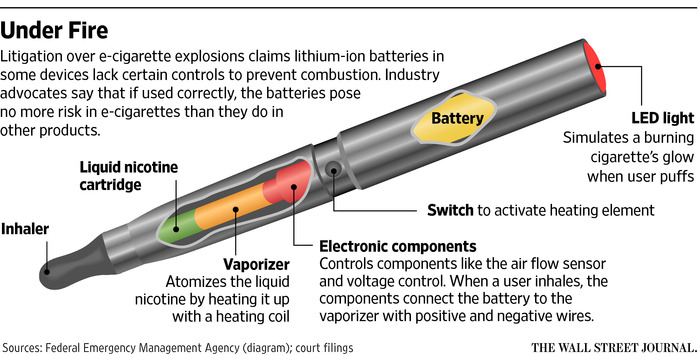
Experts hired by plaintiffs in e-cigarette lawsuits say the lithium-ion batteries can lack controls to prevent either overcharging or discharging to a voltage that is too low, which can cause combustion. The batteries also can lack a hollow center core that would allow gas to escape slowly.
Several litigants claim the batteries in the e-cigarettes they used came from a Chinese company called MXJO. E-cigarette models that appeared in several lawsuits were made by Chinese companies Sigelei, iPV Technology Co. Ltd. and Kangertech. The head of sales at Sigelei said she didn’t know anything about the lawsuits and declined to answer further questions. The other companies didn’t respond to emails and calls seeking comment.
Big tobacco companies including
Altria Group Inc.,
Reynolds American Inc., and
Imperial Brands PLC have all launched or acquired e-cigarette divisions. But the targets of the recent spate of lawsuits have mostly been smaller retailers, online merchants and manufacturers.
Gregory Conley, president of the American Vaping Association, a nonprofit that advocates for smaller businesses in the industry, said the explosion reports he has seen are largely from consumers using the wrong chargers or from incidents with more complex, customizable “mechanical mods,” which he says have fallen out of favor as vapor-product technology has advanced.
“When used and charged properly, vapor products pose no more of a fire risk than any other product that is powered by lithium-ion batteries, like cellphones or laptops,” Mr. Conley said.
—Fanfan Wang contributed to this article



 )
)