

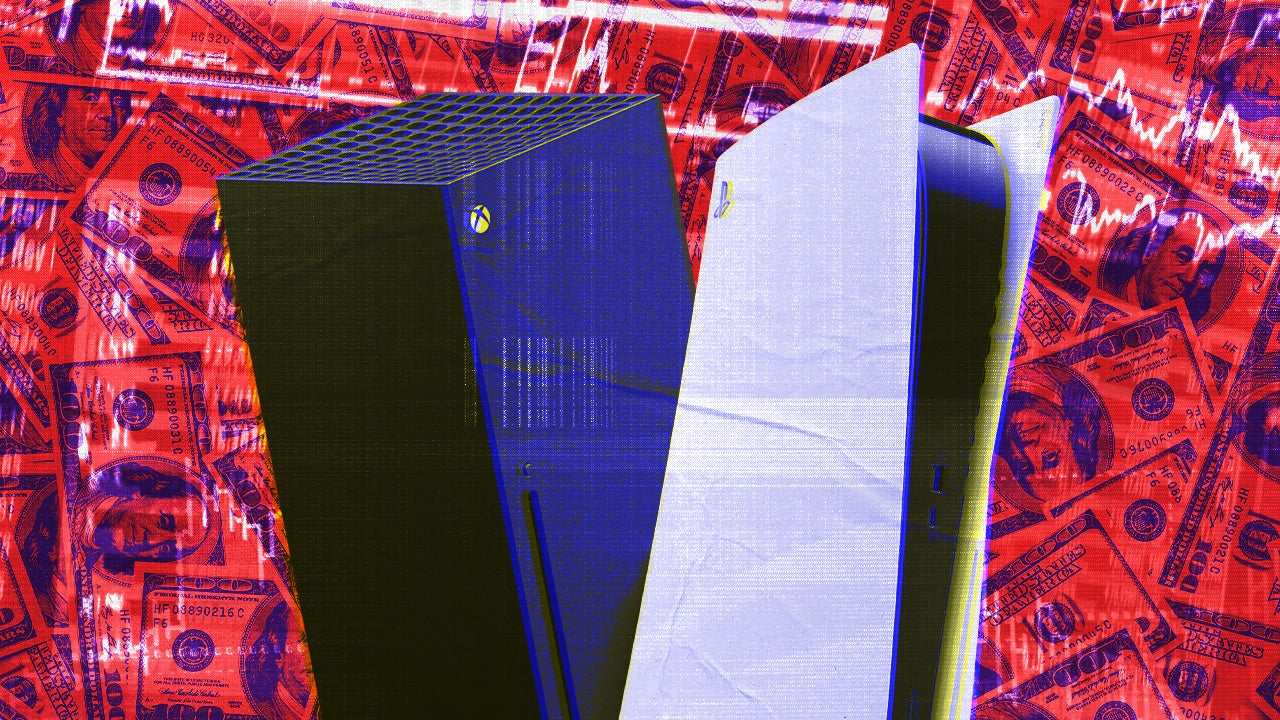
Gaming hardware is more expensive than ever. There’s a few different reasons things are as bad as they are, and I’ll get into them in a moment, but regardless of how we got here, there’s no denying it’s an absolutely terrible time to be in the market for a new gaming console or PC.
Even worse is the realization that there’s no going back.
For the past 20 years, the rough price of entry for console gaming has maxed out around $500. The Xbox and PlayStation consoles of the last three generations all launched in the $400–$500 range, and then typically got cheaper over the course of the generation thanks to less-expensive “Slim” console variants and inevitable holiday discounts.
This generation has played out differently. The PS5 and Xbox Series X both launched in 2020 at that $500 sweet spot, but in the nearly six years since have only grown more expensive. First, their launches were hampered by COVID-19 pandemic-related supply chain disruptions, leading to stock shortages that kept the price locked at or above MSRP for more than two years.
In the nearly six years since launch, the PS5 and Xbox Series X have only grown more expensive.
Supply finally started to catch up with demand around three years in, and for a brief moment it looked like we were heading into the mid-cycle point you would expect things to start getting cheaper – only for President Trump to upend the global economy with a draconian tariff regime. Sony and Microsoft raised their prices as a result, and even Nintendo, long king of the lower-performance budget-friendly realm, had to launch the Switch 2 at $449.
This storm, too, could have been weathered, but then came the chip shortage. Percolating in the background this entire generation has been a massive buildout of AI data center infrastructure, which directly caused a shortage of the memory chips used to make graphics cards, storage, and RAM. We’ve written a great deal here at IGN about this ongoing RAM crisis – how it’s the reason for an $899 PS5 Pro, $749 Xbox Series X, and why the Steam Machine costs $1,049 instead of $750. We’ve also written about how things aren’t going to get better any time soon. Valve says the memory crisis is “still getting worse,” and the CEO of RAM-maker Micron expects the shortage to last well into 2028.
So, 2029? Maybe then we’ll see a $500 console again?
Not a chance.
I fear the days of a $500 game console are long gone. For one thing, by 2029 we should be talking about the PlayStation 6 and whatever Xbox’s Project Helix ends up being called. Sure, we might see a discount on the 9-year-old PS5 and Series X by then, but I don't think the new generation has a chance of landing anywhere near the $500 launch price we’ve come to know and love.
The unfortunate reality is that by the time those next generation consoles launch, the market will have adjusted to these new, higher prices. Even if supply chains return to normal, tariffs are rescinded for good, and the RAM crisis works itself out (maybe supply catches up with demand, maybe the AI bubble bursts – who’s to say?), consumers will be used to paying close to $1,000 for their gaming hardware by then. Given that, Sony and Microsoft will have little incentive to price their new consoles any less.
Just look at how the GPU market responded to its own series of supply-related price shocks. In 2017 and again in 2020, the boom in cryptocurrency mining led to GPU shortages and scalper-driven prices well above MSRP. Both times, GPUs eventually returned to normal stock levels, but the subsequent GPU generation also saw their launch prices heavily pushed up by the inflated numbers people had grown used to forking over to scalpers.
I see no reason that things will be any different this time around.
Of course, there’s no guarantee that consumers will come out as fervently for a $1,000 console as they have for previous generations, but I have little doubt the demand will be there. The Switch 2 is the second fastest-selling console in U.S. history, despite its higher launch price. Then again, demand for the Steam Deck has cratered in the wake of its large price hikes, but that doesn’t surprise me given that there are currently better and cheaper options on the market.
The party seems to well and truly be over.
I’m not confident there will be much competition to keep the next-gen consoles in check though. Sony says it doesn’t plan to subsidize the cost of the PS6. Meanwhile, Xbox’s future is murkier than ever, but all signs point to Project Helix being more like a PC than a traditional console, and PC graphics cards aren’t getting any cheaper. That’s not even to mention that everything feels more expensive these days, as evidenced by U.S. inflation hitting a 40-year record high in 2022 and holding well above normal rates in the years since.
Adjusted for inflation, the 60GB PS3’s launch price of $600 would be close to $1,000 in today’s dollars. Viewed through that lens, perhaps we’re lucky that console prices have remained so cheap for so long. Whatever the case, the party seems to well and truly be over. Like it or not, the $500 console is gone for good.
Bo Moore is IGN's Senior Manager of Tech. You can find him online @usebomswisely.
Continue reading...