Become a Patron!

Thoughts on the Noisy Cricket

AlbyKortoona

VU Donator
Gold Contributor
Member For 4 Years
Member For 3 Years
ECF Refugee
Order placed. Would be fine with a kanthal wrap if that helps on getting resistance up. I think Nichrome gets hotter, faster? But wanting to have at least .5 dual for this nasty, errrr, noisy cricket.
 

CrazyChef

Custom Hand Crafted Coils - PureCoils.com
VU Vendor
VU Donator
Platinum Contributor
Member For 4 Years
ECF Refugee
Thank you! :D They should ship tomorrow.

The difference in resistance between nichrome and kanthal in the outer wrap is literally only a 0.001Ω difference.
 

raymo2u

VU Donator
Platinum Contributor
Member For 4 Years
Unlisted Vendor
The outer wrap does nothing electrically for resistance, and the changes it would have would be above what our devices could register. The core wires determine the resistance.
 

CrazyChef

Custom Hand Crafted Coils - PureCoils.com
VU Vendor
VU Donator
Platinum Contributor
Member For 4 Years
ECF Refugee
Once again, I don't know who started this "rumor" (for lack of a better word), but the outer wire does affect the resistance. However minor it may be. To use the old water/electricity analogy, say you had a two foot diameter pipe next to a river with water flowing freely through it. Now, say you have a one inch diameter pipe twisted around it, also open to the flow of the river. Water will flow through both pipes. The bulk of the water will take the path of least resistance, the large pipe. But, there will be some water going through the smaller pipe.

If two wires are both connected to a positive and negative terminal, there will be electricity flowing through both wires. But the electricity will obviously take the path of least resistance and most of your current will be going through your core wire(s). There will always be a smaller amount of electricity flowing through the smaller wire(s).
 
Last edited:

raymo2u

VU Donator
Platinum Contributor
Member For 4 Years
Unlisted Vendor
Once again, I don't know who started this "rumor" (for lack of a better word), but the outer wire does affect the resistance. However minor it may be. To use the old water/electricity analogy, say you had a two foot diameter pipe next to a river with water flowing freely through it. Now, say you have a one inch diameter pipe twisted around it, also open to the flow of the river. Water will flow through both pipes. The bulk of the water will take the path of least resistance, the large pipe. But, there will be some water going through the smaller pipe.

If two wires are both connected to a positive and negative terminal, there will be electricity flowing through both wires. But the electricity will obviously take the path of least resistance and most of your current will be going through your core wire(s). There will always be a smaller amount of electricity flowing through the smaller wire(s).
Yes...but its difference is negligible to the point of saying it doesnt change anything...the difference is moot
 

AlbyKortoona

VU Donator
Gold Contributor
Member For 4 Years
Member For 3 Years
ECF Refugee
The dna200 and joyetech boards will read a nickel or titanium wrapped stainless steel core clapton as Ni or Ti. So there must be something more than just "moot" running thru them...;):D
 

CrazyChef

Custom Hand Crafted Coils - PureCoils.com
VU Vendor
VU Donator
Platinum Contributor
Member For 4 Years
ECF Refugee
According to Steam Engine, my normal alien build is 0.255Ω with the Clapton, and 0.222 without it. The amount of current it draws is 3.92 amps per volt with the Clapton, and 4.5 amps per volt without.
 

vapedick

Member For 4 Years
According to Steam Engine, my normal alien build is 0.255Ω with the Clapton, and 0.222 without it. The amount of current it draws is 3.92 amps per volt with the Clapton, and 4.5 amps per volt without.
Yeah?...... What do they read on an ohm meter?
 

CrazyChef

Custom Hand Crafted Coils - PureCoils.com
VU Vendor
VU Donator
Platinum Contributor
Member For 4 Years
ECF Refugee
Yeah?...... What do they read on an ohm meter?
I haven't done them side-by-side, but I'm sure the results would be quite similar.
 

raymo2u

VU Donator
Platinum Contributor
Member For 4 Years
Unlisted Vendor
Ill test this tomorrow...

I am afriad and embarassed to admit I hope to learn something new from this test
 
Last edited:

robot zombie

Silver Contributor
Member For 4 Years
Once again, I don't know who started this "rumor" (for lack of a better word), but the outer wire does affect the resistance. However minor it may be. To use the old water/electricity analogy, say you had a two foot diameter pipe next to a river with water flowing freely through it. Now, say you have a one inch diameter pipe twisted around it, also open to the flow of the river. Water will flow through both pipes. The bulk of the water will take the path of least resistance, the large pipe. But, there will be some water going through the smaller pipe.

If two wires are both connected to a positive and negative terminal, there will be electricity flowing through both wires. But the electricity will obviously take the path of least resistance and most of your current will be going through your core wire(s). There will always be a smaller amount of electricity flowing through the smaller wire(s).
See, I've always kind of assumed that the electricity would all go down the path of least resistance as soon as possible. I know for a fact that the outer wire does affect resistance. I just don't think it's going down as you suggest it is. I see other likely possibilities that more align with my observations. Whatever the case may be, we're qualifying what should be a very minor power difference. It should come down to us just splitting hairs.

I like splitting hairs, though. And it just so happens that this is precisely the type of thing that I geek-out on. I'mma get all nitty gritty on this shit.


Just to bastardize your pipe analogy, let's say the pipes are fused together in a way wherein water can move freely between them at the point where the water first enters. As in, they start as one big opening and split off into two separate pipes further down; both wires share their connection sites directly. The smaller pipe has the interior diameter of a coffee straw while the bigger one has the diameter of a semi-engine's exhaust pipe. 99% of the flow should therefore be drawn away from the path of smaller pipe and into the bigger pipe right from the get-go.

...okay, so that's a flawed analogy. What I'm suggesting is that inside the post, both wires are squished right up against each other to the point where they start to fuse, meaning that current should be able to move freely across/between them. The outer wire and core get pushed flat against one another under the combined heat and pressure, and thus it is the most conductive point where they meet. It's just all kinds of smushed and stretched and kinked-up in there. Once the stuff around and directly outside the post has oxidized, that smushed mass of wire is gonna be the place where the current jumps, if anywhere.

What actually goes through the little guy is gonna be an extremely tiny amount (at a factor of over 100 times, likely not nearly enough to measurably change the resistance.) The path from the post, to the outer, to the lead gives to current more easily than the path from the post down the entire length of lead to the point where, given the low voltage, it is essentially inactive.

The problem I see here is that this basically defies the fundamental principle behind "following the path of least resistance." Current doesn't pick one path over another. It takes all paths to varying degrees. I have my doubts, but I also have my reasons for thinking that the current either doesn't reach the outer at all or pulls over 100 times less current (meaning we can't measure it.)

I'm just hung up on the fact the difference in resistance between bare wire and the same length of clapton can actually be measured when it shouldn't be that way.

It could also be the case that the connection to the outer wire beyond the post is being sufficiently severed from the wire inside the post as to not make enough of a connection for the voltage to overcome, leaving basically just the tiny section in there just sitting between the core and the post's interior connection sites.

In that case, we have a little series circuit between the post holes - the current goes from the post/screw to that little section and then finally to the core, where it makes its way out to the rest of the coil. If this were true, then the resistance of the section of outer wire wedged in there would stack with the resistance of the core... ...there would be no connection between the core and the outer wire beyond the posts once all contacting outer surfaces surfaces had oxidized. There would be no path for it to get there. The end result would be a slight boost in resistance from the bits of wire crammed in the post. I think this is the most likely possibility.

With these contradictory preconceptions in my head, I've always thought that the difference in resistance was a product of there being another interface point in the connection. It does flow through the outer wire, but only as far as it has to. The higher-res outer wire in the post decreases conductivity... ...the extra hop simply impedes current flow. You might be raising an eyebrow at me for saying that. I know that everything I'm saying doesn't make sense. What am I suggesting here? Hold on... ...I have my reasons.


I already know the result, but I decided to test a standard coil against its clapton counterpart for you guys who are wondering. You can actually see the nature of the difference simply by calculating-out a standard build and then reading a clapton of the same diameter/core-guage/wrap-count, but going only by the math is no fun. Check this shit out!

I did two 6-wrap, 2mm, single-coil builds: 1 is 27g kanthal, while the other is 40g/27g kanthal. I chose this because it was the only wire I had on hand that I could stand to waste. Probably not the best choice, but here we go. Prepare yourself for some of the saddest coilporn I've ever posted... ...fresh on the left, pulsed-out on the right.

Standard...
standard.jpg


Clapton...
clapton.jpg


As you can see, the clapton reads a good bit higher. This is what I have always observed when doing this in the past. The readout on the standard coil is adequately close to steam engine's estimate of .74 for a 6-wrap, 2mm, 27g single-coil. It's possible I over-tightened or the wire didn't sit right in the big post-holes and so on, but I'm gonna go ahead and assume that these are viable and accurate enough for our purposes. I actually made two attempts with the clapton. I popped the first one switching back and forth between a 100w build on my Sigelei 150 (vaping on the same mod I was testing with lol,) but before I did that, it read within .01-.02 of the one pictured, so I know the reading is fairly repeatable.


Now, if the outer wire is carrying current, then why do the claptons read higher than the standard equivalent? Shouldn't it actually be lower than the core alone if they are running in parallel? You now have two pathways that the current is traveling down. Either length of wire will pull the same current whether they are running in parallel or alone. The resistance of a parallel build will always be lower than either alone.

For instance: If you run a .5 alone at 5v, it will pull 10A. If you run a 1.0 at 5v, it will pull 5A. If you run them in parallel at 5v, they will pull a net current of 15A at their combined resistance of .33.

Lets take this math and apply it to a standard clapton by doing some reasonable approximations. Lets make a single, 10-wrap 36/24. The combined length of the coil and its legs will measure about 3.2 inches - lets call that 3 inches. It takes around 10 feet of 36g to make 6 inches of clapton wire. Therefore, our 24g core wire is 3 inches long and our 36g outer wire is 5 feet long.

3" of 24g is ~0.5 ohms.
5' of 36g is ~60 ohms. (quite the difference, eh?)

To calculate the combined resistance of two resistors in a parallel circuit, we use the formula Rt=1/(1/R1 + 1/R2). So...
1/0.5 = 2
1/60 = 0.0167
1/2.0167 = 0.496

The math says it should read the teeniest bit lower if the wires are running in parallel, just as CrazyChef proposed, but the reality doesn't reflect that, so what's going on here?

Can anybody see why I might be reaching for such contradictory conclusions? Not saying my theory is correct by default. Just suggests there's something strange going on, perhaps even something that none of us have considered. My interpretation of these facts is just that - an interpretation based on just a few observations and logic. My actual understanding of this is limited by my lack of knowledge. Maybe I'm overthinking it all and I've just wasted a lot of my time, not to mention that of the people reading this.

If anything, it's a simple matter of conductivity. Perhaps the outer wire at the connection sites are bottlenecks. It's the only thing that makes any sense to me.

I would like to encourage you guys to try it with different wires and atties so we can compare results. Could be interesting for those of you who want to split hairs. Perhaps if the gap in resistance shortens, it starts behaving like a regular parallel circuit. That would explain it right there. It would have to be a connection issue.

Who wants to build a perfect clapton coil, take a reading, pull it apart, and measure the lengths of both wires? By testing every possible combo, we could take that and use the existing algorithms to accurately predict the resistance of all claptons and stop worrying about this nonsense! o_O;):cool:
 
Last edited:

dre

Platinum Contributor
ECF Refugee
Member For 5 Years
According to Steam Engine, my normal alien build is 0.255Ω with the Clapton, and 0.222 without it. The amount of current it draws is 3.92 amps per volt with the Clapton, and 4.5 amps per volt without.
That slight resistance change is due to the Clapton wire increasing the internal diameter of the coil. It will be the same without wrap if you added the clapton wires diameter to a normal coil.

Sent from my Droid Turbo 2 using Tapatalk
 

vapedick

Member For 4 Years
That slight resistance change is due to the Clapton wire increasing the internal diameter of the coil. It will be the same without wrap if you added the clapton wires diameter to a normal coil.

Sent from my Droid Turbo 2 using Tapatalk
You win!


Sent from my iPhone using Tapatalk
 

AlbyKortoona

VU Donator
Gold Contributor
Member For 4 Years
Member For 3 Years
ECF Refugee
Very nice robot zombie, more food for thought than I have a capacity to digest but quite interesting. There is a reason Doctorates in electrical theory are available. I have seen very smart people raise their eyebrows while listening to someone profess their "understanding" of electricity. At any rate, your effort is appreciated. Now get to work on the questions you raised...;)
 

chris.ardito.3

Silver Contributor
Member For 4 Years
My authentic freak show and mutation Xs are RDA's ok with the noisy cricket?


Sent from my iPhone using Tapatalk
 

Virol

Member For 4 Years
Member For 3 Years
Sorry for interrup guys, i'm new on the noisy cricket, if i did nderstand it's safe to vape with coils between .3 and .7?
and also, i'm planing to use it with the indestructible, but i have the TFV 4 mini, can i use itwith the NC too? or the pin is too short?
 

Attachments

  • images.jpg
    images.jpg
    9.8 KB · Views: 20

robot zombie

Silver Contributor
Member For 4 Years
That slight resistance change is due to the Clapton wire increasing the internal diameter of the coil. It will be the same without wrap if you added the clapton wires diameter to a normal coil.
Makes sense. I have a dual fused 36/28 that only runs .02 higher. Could see that difference being due to the 36 outer making the wraps just a tad bigger. I've been going on the assumption that the difference in diameter is so small as to not have a significant impact, though it might with thicker gauges of outer wire. I have tunnel vision there because I usually clapton with 38g and smaller. 38g is .1mm across. An extra .2mm in the diameter leads to a slight <0.1 increase in most cases, which doesn't really explain why the jump is usually at least double that.

I quite often do a 2mm, 8-wrap, dual 38/28 single-core clapton that typically reads .68 when it should read .6. There's no way the super-thin 38g is adding that much diameter to the core wraps. Something else must be happening there. I still think it's a connection thing.

Very nice robot zombie, more food for thought than I have a capacity to digest but quite interesting. There is a reason Doctorates in electrical theory are available. I have seen very smart people raise their eyebrows while listening to someone profess their "understanding" of electricity. At any rate, your effort is appreciated. Now get to work on the questions you raised...;)
Haha I've already burned myself out to it just thinking about it. To someone who went to school for this stuff, it's peanuts. A lot of it goes against very fundamental principles of how electricity has been observed to behave. And I'm more than likely not providing meaningful explanations. I presented ridiculous ones to highlight the possibility that there are missing pieces that would make it all make sense within the confines of the laws of physics. Through all of that nonsense, I am suggesting that there has to be a more rational explanation that I'm not seeing... ...because there's no way what I'm saying could possibly true. It's more a testament to how confused I am than how much I have figured out.

I just woke up. This hurts my head. But thank you. :)
LMAO, I stayed up late writing it. That's my sleep medication. Always leaves me feeling groggy the following day....

Sorry for interrup guys, i'm new on the noisy cricket, if i did nderstand it's safe to vape with coils between .3 and .7?
and also, i'm planing to use it with the indestructible, but i have the TFV 4 mini, can i use itwith the NC too? or the pin is too short?
Lol, you're more on topic that we are. Not sure about the TFV4 (can't find any shots showing the pin, but it looks flush) but the indestructible is fine - it's practically made to pair with the NC and looks/performs quite nicely. People generally tend to frown upon using tanks with hybrids. Hasn't gone too well in the past.

It is safe to vape at .3, but ill-advised. The amp draw is within what 30A batteries can handle... ...it's just too much power for most coils to not scorch whatever hits them. I'd recommend starting at .5 and above. A .5 puts you at ~115w in practice. If in doubt, play with the numbers in steam engine's battery calulator. Just remember to double the voltage. Take the wattage you get at the resistance you plug-in and take it over to the heat flux calculator in the coil building section and start plugging in different coils you can build at that resistance to get an idea of what will actually be vapable.
 
Last edited:

dre

Platinum Contributor
ECF Refugee
Member For 5 Years
Makes sense. I have a dual fused 36/28 that only runs .02 higher. Could see that difference being due to the 36 outer making the wraps just a tad bigger. I've been going on the assumption that the difference in diameter is so small as to not have a significant impact, though it might with thicker gauges of outer wire. I have tunnel vision there because I usually clapton with 38g and smaller. 38g is .1mm across. An extra .2mm in the diameter leads to a slight >0.1 increase in most cases, which doesn't really explain why the jump is usually at least double that.

I quite often do a 2mm, 8-wrap, dual 38/28 single-core clapton that typically reads .68 when it should read .6. There's no way the super-thin 38g is adding that much diameter to the core wraps. Something else must be happening there. I still think it's a connection thing.


Haha I've already burned myself out to it just thinking about it. To someone who went to school for this stuff, it's peanuts. A lot of it goes against very fundamental principles of how electricity has been observed to behave. And I'm more than likely not providing meaningful explanations. I presented ridiculous ones to highlight the possibility that there are missing pieces that would make it all make sense within the confines of the laws of physics. Through all of that nonsense, I am suggesting that there has to be a more rational explanation that I'm not seeing... ...because there's no way what I'm saying could possibly true. It's more a testament to how confused I am than how much I have figured out.


LMAO, I stayed up late writing it. That's my sleep medication. Always leaves me feeling groggy the following day....


Lol, you're more on topic that we are. Not sure about the TFV4, but the indestructible is fine - it's practically made to pair with the NC and looks/performs quite nicely. The MX line is iffy. Personally, I use them because I'm an arrogant prick like that, but the pin is rather short and doing so can be risky.

It is safe to vape at .3, but ill-advised. The amp draw is within what 30A batteries can handle... ...it's just too much power for most coils to not scorch whatever hits them. I'd recommend starting at .5 and above. A .5 puts you at ~115w in practice. If in doubt, play with the numbers in steam engine's battery calulator. Just remember to double the voltage. Take the wattage you get at the resistance you plug-in and take it over to the heat flux calculator in the coil building section and start plugging in different coils you can build at that resistance to get an idea of what will actually be vapable.
Don't forget the spacing of the coils due to the wraps also adds length to the core wire which will also add resistance :)

Sent from my Droid Turbo 2 using Tapatalk
 

robot zombie

Silver Contributor
Member For 4 Years
Don't forget the spacing of the coils due to the wraps also adds length to the core wire which will also add resistance :)
Hmmm, I wish I could find a way to mimic that in a bare wire and test it. You may just be right on the money.
 

raymo2u

VU Donator
Platinum Contributor
Member For 4 Years
Unlisted Vendor
Sorry for interrup guys, i'm new on the noisy cricket, if i did nderstand it's safe to vape with coils between .3 and .7?
and also, i'm planing to use it with the indestructible, but i have the TFV 4 mini, can i use itwith the NC too? or the pin is too short?
You wouldnt want to use your TFV4 on it unless your using the RBA with a single coil....
Im not sure if the 510 on the TFV4 would work on a hybrid
 

dre

Platinum Contributor
ECF Refugee
Member For 5 Years
Hmmm, I wish I could find a way to mimic that in a bare wire and test it. You may just be right on the money.
You can figure all that in steam engine. Just add the wire diameter of the Clapton for spacing and internal diameter.

Sent from my Droid Turbo 2 using Tapatalk
 

raymo2u

VU Donator
Platinum Contributor
Member For 4 Years
Unlisted Vendor
Makes sense. I have a dual fused 36/28 that only runs .02 higher. Could see that difference being due to the 36 outer making the wraps just a tad bigger. I've been going on the assumption that the difference in diameter is so small as to not have a significant impact, though it might with thicker gauges of outer wire. I have tunnel vision there because I usually clapton with 38g and smaller. 38g is .1mm across. An extra .2mm in the diameter leads to a slight >0.1 increase in most cases, which doesn't really explain why the jump is usually at least double that.

I quite often do a 2mm, 8-wrap, dual 38/28 single-core clapton that typically reads .68 when it should read .6. There's no way the super-thin 38g is adding that much diameter to the core wraps. Something else must be happening there. I still think it's a connection thing.


Haha I've already burned myself out to it just thinking about it. To someone who went to school for this stuff, it's peanuts. A lot of it goes against very fundamental principles of how electricity has been observed to behave. And I'm more than likely not providing meaningful explanations. I presented ridiculous ones to highlight the possibility that there are missing pieces that would make it all make sense within the confines of the laws of physics. Through all of that nonsense, I am suggesting that there has to be a more rational explanation that I'm not seeing... ...because there's no way what I'm saying could possibly true. It's more a testament to how confused I am than how much I have figured out.


LMAO, I stayed up late writing it. That's my sleep medication. Always leaves me feeling groggy the following day....


Lol, you're more on topic that we are. Not sure about the TFV4 (can't find any shots showing the pin, but it looks flush) but the indestructible is fine - it's practically made to pair with the NC and looks/performs quite nicely. People generally tend to frown upon using tanks with hybrids. Hasn't gone too well in the past.

It is safe to vape at .3, but ill-advised. The amp draw is within what 30A batteries can handle... ...it's just too much power for most coils to not scorch whatever hits them. I'd recommend starting at .5 and above. A .5 puts you at ~115w in practice. If in doubt, play with the numbers in steam engine's battery calulator. Just remember to double the voltage. Take the wattage you get at the resistance you plug-in and take it over to the heat flux calculator in the coil building section and start plugging in different coils you can build at that resistance to get an idea of what will actually be vapable.
I like it around .4 but I wish it would be a tad warmer...
2x28K/40N80 Fused Claptons @ .43 Ohms....I may try some .36-.38 variations just to see if it helps at all...
 

Attachments

  • 20160221_132414.jpg
    20160221_132414.jpg
    224.4 KB · Views: 24
  • 20160221_132319.jpg
    20160221_132319.jpg
    240.6 KB · Views: 25
  • 20160221_132445.jpg
    20160221_132445.jpg
    252.7 KB · Views: 19

robot zombie

Silver Contributor
Member For 4 Years
Use this table
52b77d07fb0f9b670e31b17c85550f1b.jpg


Sent from my Droid Turbo 2 using Tapatalk
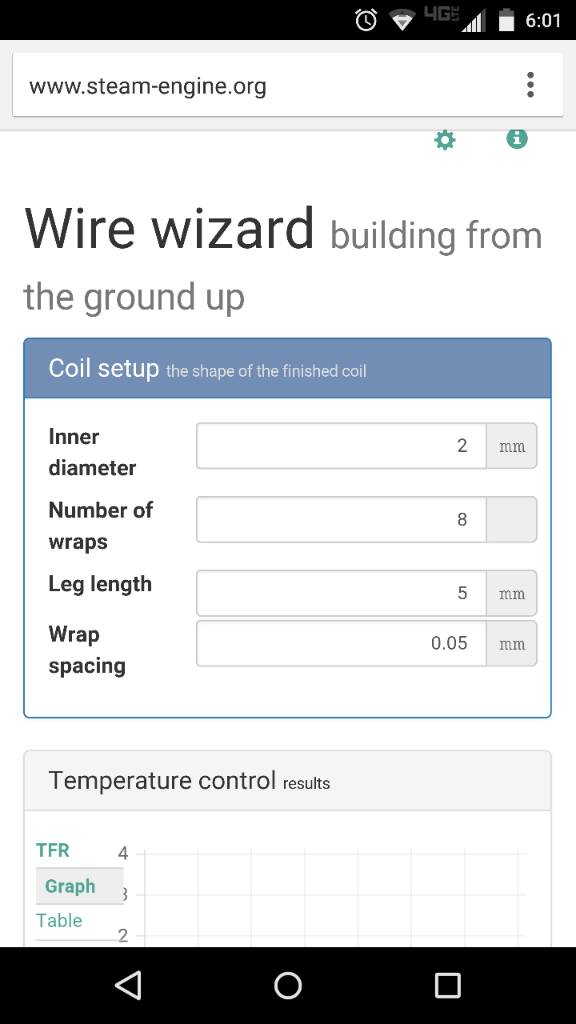
I did it like this... ...the diameter of 38g is .1, so we have a .2 diameter increase total. Same for the wrap spacing.
coilz2.jpg

Little extra distance and wrap size aside, the final rounded resistance is not far off enough from the bare wire equivalent:
coilz.jpg

Again, I could see thicker wire being of more consequence, but if anything, that just means the difference will be even greater than this sort of calculation alone would show.
 

Virol

Member For 4 Years
Member For 3 Years
Well i just put the TFV4 mini on the NC, bad idea, the pin is not long enought, lucky me i was just testing XD!!!
i'm seen the griffin or another RTA tha have the positive pin long enough, but right now i'm watching the twisted messes 2.

thanks for the answare, i'll start on .5ohms builds.
 

dre

Platinum Contributor
ECF Refugee
Member For 5 Years
Leg length should be more unless the coils leg is super short. The number is the total of both legs on one side.

Sent from my Droid Turbo 2 using Tapatalk
 

robot zombie

Silver Contributor
Member For 4 Years
Leg length should be more unless the coils leg is super short. The number is the total of both legs on one side.
I figured its arbitrary for comparing two hypothetical models. As long as it's the same for both, it shouldn't matter, since we're comparing minor differences in size. To put different leg lengths for either one would only skew the comparison.
 

dre

Platinum Contributor
ECF Refugee
Member For 5 Years
I figured its arbitrary for comparing two hypothetical models. As long as it's the same for both, it shouldn't matter, since we're comparing minor differences in size. To put different leg lengths for either one would only skew the comparison.
Oh I thought you were figuring a real life build. I'll just leave it to some voodoo magic.

Sent from my Droid Turbo 2 using Tapatalk
 

robot zombie

Silver Contributor
Member For 4 Years
Oh I thought you were figuring a real life build. I'll just leave it to some voodoo magic.
Well, it's based on one that I do, but I was trying to isolate what you were taking about in it. Seems it's just one piece of the puzzle.

I agree, though... ...haha. There's some juju about it... ...and maybe a little mojo.

All I know (and perhaps all anyone needs to know,) is that claptons read significantly higher than their bare equivalents, for reasons... ...reasons, man.

I think its time to move on and go back to talking about the cricket. We could make a whole thread about claptons and we'd never see the end of it.
 

AnthonyLouis

Silver Contributor
Member For 4 Years
Unlisted Vendor
Anyone else having issues with their noisy cricket? I have it not even 24 hrs abd now I can't get it to fire....

Sent from my HTC One_M8 using Tapatalk
 

AnthonyLouis

Silver Contributor
Member For 4 Years
Unlisted Vendor
Batteries are fine , atty makes a.connection. Idk what else it could be

Sent from my HTC One_M8 using Tapatalk
 

AlbyKortoona

VU Donator
Gold Contributor
Member For 4 Years
Member For 3 Years
ECF Refugee
Pull the bottom plate and check the insulator on the rocker panel connector.
 

RonaldStark

Member For 4 Years
Member For 3 Years
Member For 2 Years
Member For 1 Year
A .5 single has to be pretty hot. You're probably going to want to try duals that ohm above that. 28/38 single cores at .8-.9, maybe. Should keep the ramp-up reasonable, flavor and density will be there, but it won't have enough power for its surface area to get past warm.

You could also try standard dual 26g at around an ohm. With 28, you can get away with going beyond an ohm.

If you're set on that staggered single coil flavor profile, then yeah, you can also do fused 28 or 30.

Whatever you do, you've got to get that resistance up. Realistically, that .5 single is getting 115w.

So after more experimenting with different smaller gauge claptons and fused claptons I finally settled on the simple 26 g .9 ohm that you had suggested, on my derringer it's just perfect for me. Plenty of surface area warm (but not too much) and dense, and in unison with the battery life I'm getting? It's been my all day set up for the past week. Thanks for the tip! Occam's razor can be the most useful building tool :)


Sent from my iPhone using
 

robot zombie

Silver Contributor
Member For 4 Years
Batteries are fine , atty makes a.connection. Idk what else it could be
Hmm, few things could be causing that. Make sure you screw the atty into the topper and then screw the topper down before finally bringing the button down. If it doesn't fire, then the button might need some more throw. Take a hex key and bring it out a quarter to half-turn and see if that doesn't solve your problem. That is the first possible problem and the easiest to fix. Conversely, it may have gotten loose and your throw is offset, in which case you just need to tighten it down.

If that doesn't work then either your button or the sled needs cleaning. I've mentioned it before, but even a hair on one of the sled's contacts is enough to kill the connection. Stuff gets down in there and you can't see it until you pull the bottom out.

Personally, I would break the whole thing down and clean every thread and contact. One thing about the cricket... ...the connection is finicky when the components aren't clean... ...especially the button. I personally use rubbing alcohol and q-tips. I soak the metal parts of the button and topper for a couple of minutes before I start taking the q-tips to em. Whether or not this will lead to rusting, I have yet to find out. I figure if you don't let the alcohol sit on there under open air, it won't have enough time to draw condensation.

So after more experimenting with different smaller gauge claptons and fused claptons I finally settled on the simple 26 g .9 ohm that you had suggested, on my derringer it's just perfect for me. Plenty of surface area warm (but not too much) and dense, and in unison with the battery life I'm getting? It's been my all day set up for the past week. Thanks for the tip! Occam's razor can be the most useful building tool :)
Haha, cheers! I started off doing something like that, too. I stuck with it for weeks before I started experimenting again cuz Iunno... ...it just vaped. 26 is to series what 24 is to single-battery mechs... ...when tuned right it just rests on that perfect upper-middle ground.
 

AlbyKortoona

VU Donator
Gold Contributor
Member For 4 Years
Member For 3 Years
ECF Refugee
What are the indicators of pre-venting on lithium ion batteries? Would the case of the NC get hot before it went off like a sky rocket?
 

raymo2u

VU Donator
Platinum Contributor
Member For 4 Years
Unlisted Vendor
What are the indicators of pre-venting on lithium ion batteries? Would the case of the NC get hot before it went off like a sky rocket?
The batteries get so hot they cannot be held and increasing in heat rapidly, you may smell a nasty fume or hear gurgling (this is while is about to vent or venting though)
 

AlbyKortoona

VU Donator
Gold Contributor
Member For 4 Years
Member For 3 Years
ECF Refugee
That was my guess, and it makes me wonder how the knuckleheads who make the news manage to vent their batteries with no clue as to what is about to happen.
 

raymo2u

VU Donator
Platinum Contributor
Member For 4 Years
Unlisted Vendor
That was my guess, and it makes me wonder how the knuckleheads who make the news manage to vent their batteries with no clue as to what is about to happen.
The battery also matters...you have never heard of a Samsung or LG or Sony venting or going into thermal runaway on the news...its always a rewrap or Class B/C Battery...Ive never vented a 25R even with some insane builds and hard shorting them..
 

AlbyKortoona

VU Donator
Gold Contributor
Member For 4 Years
Member For 3 Years
ECF Refugee
Outside of Basen and MNKE 26650 for the Stout, those 3 are the only brands I ever use. Did the hard shorts come from coil/barrel contact? How quickly did the battery start to heat up? Appreciate any heads up on this stuff so I can try to avoid any unpleasant situations. :) Thx
 

raymo2u

VU Donator
Platinum Contributor
Member For 4 Years
Unlisted Vendor
Outside of Basen and MNKE 26650 for the Stout, those 3 are the only brands I ever use. Did the hard shorts come from coil/barrel contact? How quickly did the battery start to heat up? Appreciate any heads up on this stuff so I can try to avoid any unpleasant situations. :) Thx
The battery heats up to untouchable heat in less then a second, its pretty instantaneous. I hard shorted by touching contacts on a mech mod.
 

AnthonyLouis

Silver Contributor
Member For 4 Years
Unlisted Vendor
Hmm, few things could be causing that. Make sure you screw the atty into the topper and then screw the topper down before finally bringing the button down. If it doesn't fire, then the button might need some more throw. Take a hex key and bring it out a quarter to half-turn and see if that doesn't solve your problem. That is the first possible problem and the easiest to fix. Conversely, it may have gotten loose and your throw is offset, in which case you just need to tighten it down.

If that doesn't work then either your button or the sled needs cleaning. I've mentioned it before, but even a hair on one of the sled's contacts is enough to kill the connection. Stuff gets down in there and you can't see it until you pull the bottom out.

Personally, I would break the whole thing down and clean every thread and contact. One thing about the cricket... ...the connection is finicky when the components aren't clean... ...especially the button. I personally use rubbing alcohol and q-tips. I soak the metal parts of the button and topper for a couple of minutes before I start taking the q-tips to em. Whether or not this will lead to rusting, I have yet to find out. I figure if you don't let the alcohol sit on there under open air, it won't have enough time to draw condensation.


Haha, cheers! I started off doing something like that, too. I stuck with it for weeks before I started experimenting again cuz Iunno... ...it just vaped. 26 is to series what 24 is to single-battery mechs... ...when tuned right it just rests on that perfect upper-middle ground.
So its my VtC5s that don't fire. My MxJOs do.

Sent from my HTC One_M8 using Tapatalk
 

AlbyKortoona

VU Donator
Gold Contributor
Member For 4 Years
Member For 3 Years
ECF Refugee
The battery heats up to untouchable heat in less then a second, its pretty instantaneous. I hard shorted by touching contacts on a mech mod.

Thinking about this prompted me to do some research (instead of just hitting up raymo for info ;)) and feel comfortable with the IMR chemistry of the batteries he mentioned. I did get a couple heat sinks to use with attys that looked a little iffy on pin length. The Kepler is a POS, dual screw pin that has poor conductivity. The Vapeheart Tomato, yeah stupid name, is good quality and has a one piece pin. Got the stainless steel version, and liked it enough to order another in copper.

http://www.ebay.com/itm/Stainless-V...nned-Heat-Sink-for-Atomizers-RBA-RDA-MOD-Atty
 

robot zombie

Silver Contributor
Member For 4 Years
So its my VtC5s that don't fire. My MxJOs do.
That's bizarre.

A couple of years ago, I had that problem with that very same battery in my SMPL. I had been using it in a mod with too short of a sled. It made a small depression in the positive contact of the battery and it wouldn't make contact with the positive on the RDA. Backed-out the 510 pin a smidge and it worked fine.

It's gotta be one of the batteries one way or another. Have you tried flipping the orientation of them? How are the wraps? Any imperfections on the bottom? Or more importantly, will these batteries power-up a regulated mod? Do they charge?
 

AnthonyLouis

Silver Contributor
Member For 4 Years
Unlisted Vendor
yeah i flipped them, no go. in actually using them in my Sigelei 100w right now, flawless.... wraps are ok, fairly new .... its so weird

Sent from my HTC One_M8 using Tapatalk
 

VU Sponsors

Top