

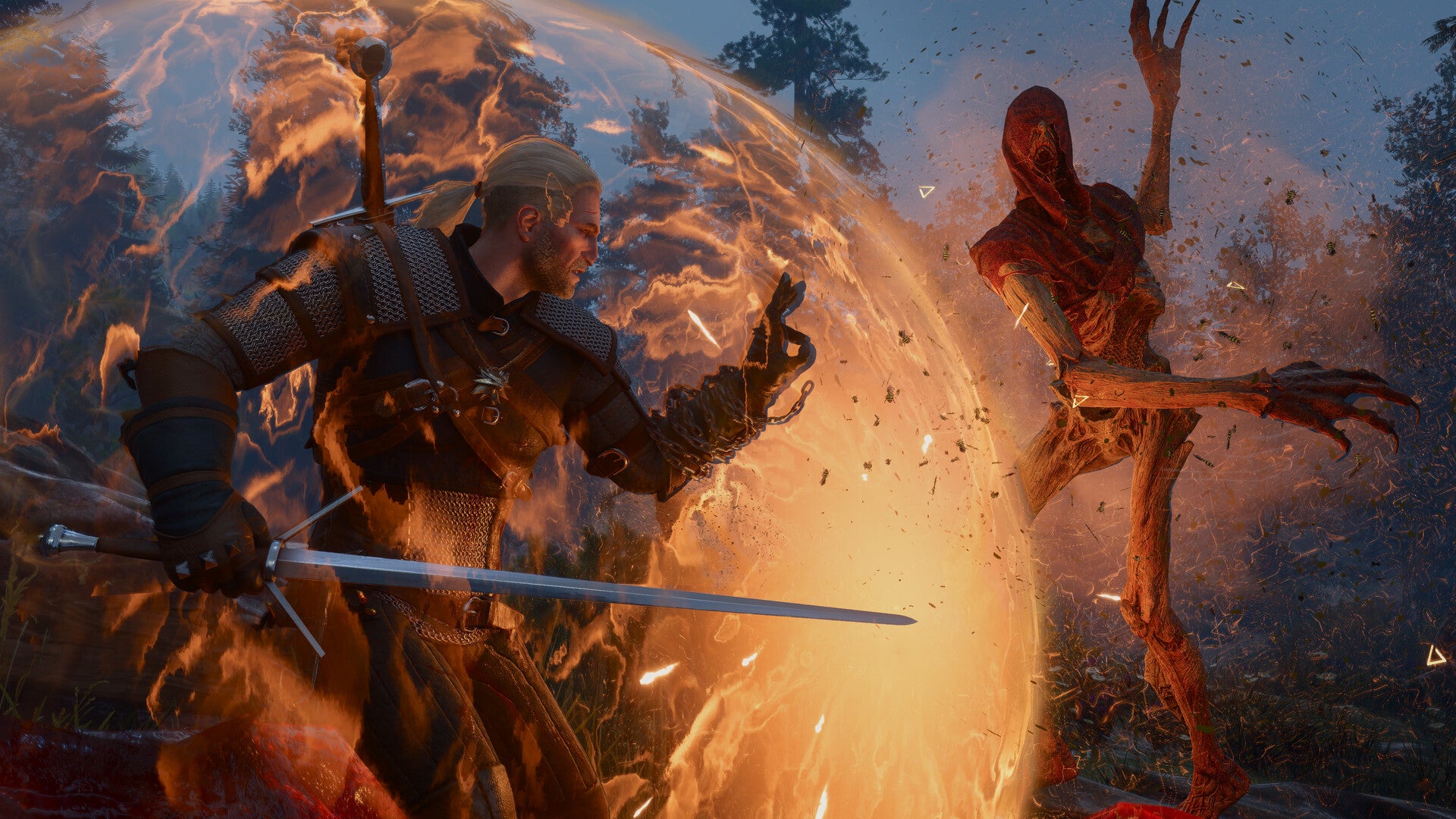
Geralt carefully circles the Swarmion, his steps slowly overlapping as he sizes up his foe. The creature could be easily mistaken for any generic fantasy undead or humanoid mutant, were it not for the cloud of hornets that swarm around its torso – a bizarre form of armour by any stretch of the imagination. But our Witcher is as resourceful as ever. He switches his silver sword for a chain, swinging the hooked end round and round as he chooses his target. The creature's legs, or its head? The answer is obvious. The hook sinks into the fleshy neck and pulls taught, wrenching the creature out of the hornet swarm and pulling it directly into the path of Geralt’s blade. Blood plumes from its neck. The head falls with a dull thud.
The silver chain is an important weapon for Geralt of Rivia. Those who have been there from the beginning will remember it from The Witcher’s very first cutscene, back in 2007. Those who have been there from the actual beginning will know it from the short story within The Last Wish collection, from which that cutscene was adapted. The important thing is that it’s part of Geralt’s core Witcher gear – and so it’s only fitting that we finally get to use it in what could well be the last time we get to play as him.
Songs of the Past is The Witcher 3’s unexpected third expansion pack, which will launch next year – 12 years after the base game was originally released, and a year ahead of the series’ in-development fourth game, which passes the protagonist baton to Ciri. And Geralt’s chain-swinging monster battle was just one small section of an hour-long demo I watched at gamescom 2026, during which a member of the CD Projekt Red dev team played through the ‘A Bed of Thorns’ quest, an early chapter that establishes Songs of the Past’s story.
Geralt awakens in Letten, the homeland of his frequent partner-in-heroics, Dandelion. While much of Geralt’s life has been well documented across both Witcher books and games, Dandelion’s history is a little more of an enigma – one that Songs of the Past seems primed to crack. The quest’s opening sees Geralt trek towards a grand hilltop estate, the home where Dandelion grew up not as a bard, but as Julian Alfred Pankratz, Viscount de Lettenhove. It’s not hard to see why he left this life of nobility behind; Geralt endures a painfully tense meal with Dandelion’s incredibly stern grandmother, a woman who would make even the most pampered person want to run away from home. Also present is Lilla, Dandelion’s cousin – a much more agreeable woman and Geralt’s new companion (plus, of course, potential target of affection – although this playthrough ignored any flirtatious dialogue options.)
I hesitate to make a judgement call on Songs of the Past's writing at this early stage, but I'll understand if you've some reservations - rather than purely CD Projekt Red behind the wheel, this expansion is the work of Fool's Theory, a different studio (although one that is made up of many CDPR veterans). Thankfully, what I've seen so far suggests the quality bar has been maintained. Within just a single scene I had a very good idea of who these two women were and how their values complimented or clashed with Geralt's own well-established code.
Not at the table is surely the reason Geralt came here in the first place; his faithful bard is nowhere to be seen. And so begins Geralt and Lilla’s mission to seek out Dandelion and bring him home. But where to start? Well, in dreams: during the night Geralt had visions of blood, thorns, violets, and a well – an image Lilla recognises as The Garden of Thorns. The two meet later that day to head out in search of what should just be a bad story, but is very quickly going to become a horrifying reality.

Letten is a beautiful place, divorced from the woes of The Continent. In that way it’s a little like Blood and Wine’s idyllic Toussaint, and the comparisons don’t stop there: CD Projekt Red says to expect something of a comparable size, so it may well be that Songs of the Past extends as far as 30 or so hours. Geralt explores the old and new sides of the town, and we pass by rows of bushes entwined with wild flowers – there’s a little of Nordic midsummer in its design, blended with English and Polish countryside. It all looks beautiful, helped by the newly-announced remaster, which upgrades The Witcher 3’s technology base with higher-resolution textures and path-tracing lighting. It would be disingenuous to say it makes this decade-old RPG look like a game from the current console generation, but it’s nonetheless a beautiful thing, particularly when it comes to natural environments caught in the final rays of the day’s sun.
Letten is a beautiful place, divorced from the woes of The Continent. In that way it’s a little like Blood and Wine’s idyllic Toussaint.
But a Witcher’s job rarely stays in pleasant territory. It’s not long before Geralt and Lilla have journeyed beyond the town’s borders and found themselves in more cursed lands. Knotted trees with twisted branches form the edge of an arena in which Geralt does battle with a Thornbloom, a large vine-like plant that can cause fields of large bulbs to grow and subsequently explode. While the remaster and, by extension, Songs of the Past benefit from an upgraded combat system, it’s not obvious in this fight how substantial the change is – this very much looks like Witcher combat as usual. A little later, when the Swarmion and its hornet shield turn up, it becomes clear that the chain does add some extra flair to the proceedings, and I like that in a moment of slow-motion you’re able to target what body part Geralt sinks the hook into before grappling a far-off enemy into melee range. But until I go hands-on with the new system I’m going to assume the changes are subtle tweaks rather than a revolutionary overhaul.

Similarly, CD Projekt Red didn’t dedicate much time to exploring Geralt’s upgraded character progression systems, so it’s as yet unclear just how different things are compared to the original version. What I did see, however, were new skill pages that re-arrange the layouts of the abilities in more of a distinct tree shape, so it may be that there’s been a re-thinking of how you progress Geralt through his RPG upgrades… or at least a re-thinking of how that progression is communicated.
Geralt and Lilla continue to push through the forest and eventually make their way to a tightly-woven wall of thorns, its branches laced with violets and human skulls. At its base lies a dying deer, its blood soaked up by the horrifying structure. This is the gate to the Garden of Thorns. Beyond lies answers to the mystery of our missing Dandelion. In another playthrough, Geralt may well have used his intellect to coax those branches open – CD Projekt Red promises that there are multiple ways to navigate this problem. In the interest of time, though, the developer controlling the demo takes the path of violence, slicing the gate apart. The strike causes the garden to grow vines between Geralt and Lilla, separating them. Perhaps this is the consequence for not seeking out a more careful approach to the situation? Either way, Geralt is forced to fight through Giant Centipedes and those aforementioned Swarmions to find his way back to Lilla… and the well.
Yes, the well from Geralt’s dream is real, and defended by the Slumbering Knight, this demo’s boss fight. A noble corpse that’s become half tree, it’s able to strike and defend itself with a huge, bark-shrouded arm. But that’s not the interesting thing: around its neck is a chain finished with a horse pendant. The sigil of Lettenhove. This withered warrior is a member of Dandelion’s own house… or at least was, once upon a time. Thankfully, despite the signs this man once wore flamboyant costuming, there’s no suggestion this is Dandelion himself. The search goes on, and the next location is obvious: down the well. Will there be a devil in this one?
Not quite. But the twisted wooden figure within it, which you saw during the trailer for Songs of the Past shown at Opening Night Live, could well be mistaken for one. Quite what it is remains to be seen, as that’s where the gamescom demo suddenly cuts to black. But, considering its prominence in said trailer, this creature likely lies at the heart of this Dandelion-themed mystery.
This first taste of Songs of the Past doesn’t offer up anything radically new or unexpected. This is more of The Witcher 3, even with its remastered tech base and updated combat and ability systems. But it’s wise not to approach this project with the expectations of “new” Witcher – this is an expansion for a 11 year old game, after all. Save that enthusiasm for The Witcher 4. But still, this is an 11 year old game that has summoned me back numerous times already, and even as its joints get creaky, it’s always incredibly clear why The Witcher 3 is a generational-defining RPG. To be able to revisit it once more to play through a whole new story, meet brand new characters, and explore a rich new setting isn’t something I thought I’d ever get to do, and so in some ways that’s more interesting than a brand new game – perhaps with Songs of the Past, CD Projekt Red and Fool's Theory has found a way to make coming back to a well-loved home feel like the first time all over again.
Matt Purslow is IGN's Executive Editor of Features.
Continue reading...