

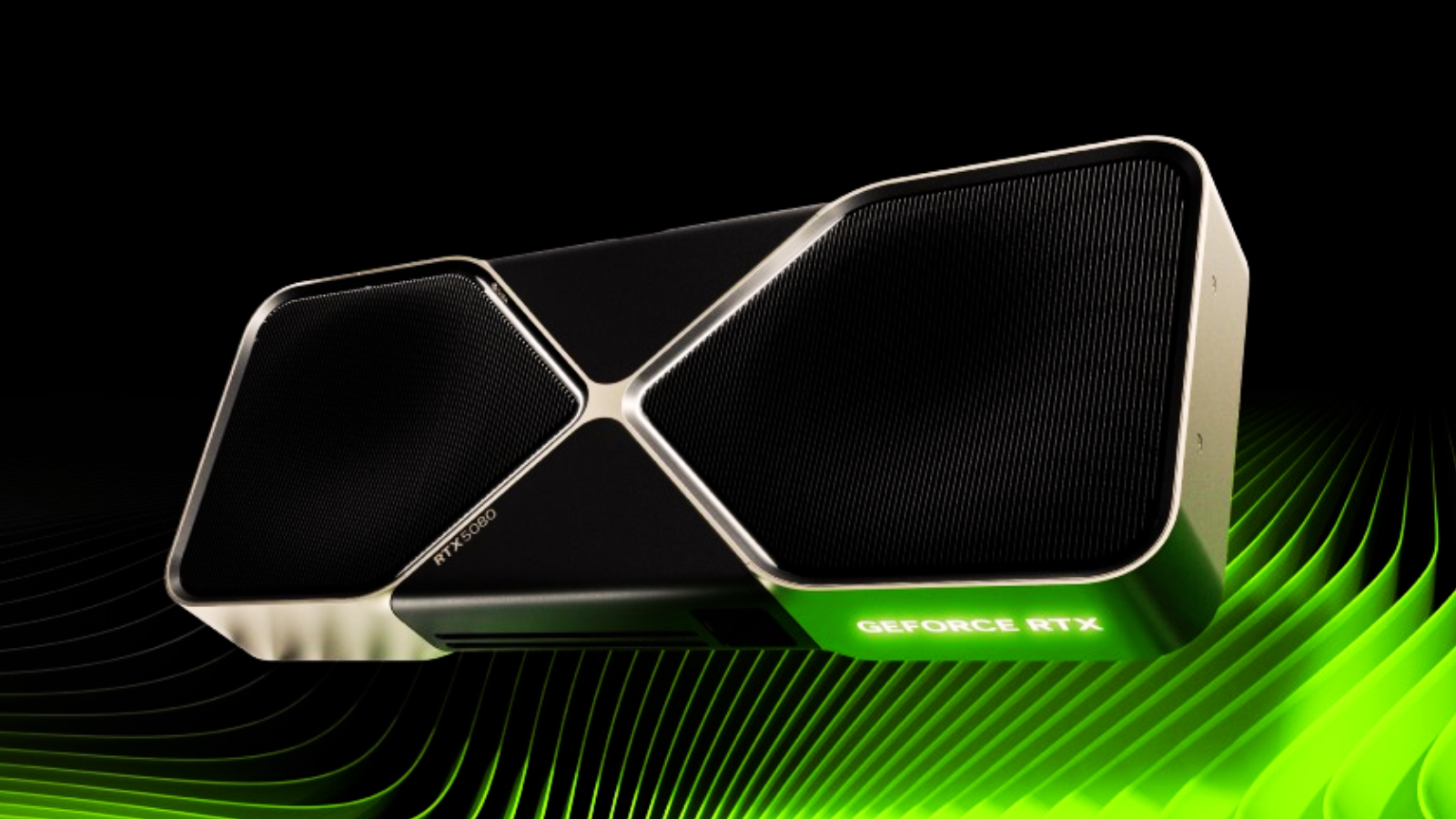
RTX 5080 is finally here, and if you're in the UK, getting your hands on one will take some strategy. Nvidia's latest high-end GPU packs serious power with its new Blackwell architecture upgraded DLSS 4, and blisteringly fast GDDR7 memory. Retailers are stocking up, but if previous GPU launches have taught us anything, supply will be limited, scalpers will be lurking, and the best deals won't last long.
Where To Buy GeForce RTX 5080 In The UK
If you're ready to buy, you'll need to act fast. The usual suspects — (Amazon, Overclockers UK, Scan, Box, and Currys) are all expected to stock RTX 5080, although stock will vary. Some retailers will offer bundle deals, while others may have exclusive models from brands like ASUS, MSI, and Gigabyte. Keeping an eye on stock alerts, signing in to accounts ahead of time, and using financing options or cashback offers can all help you secure one before it disappears. Let's break down where to buy the RTX 5080 in the UK and how to improve your chances of snagging one at retail price.
Who Is Selling GeForce RTX 5080 In The UK?
You've got several solid options, but the stock will go fast. Major retailers like Amazon, Currys, and Box.co.uk will likely have models from ASUS, MSI, and Gigabyte, with some exclusive bundles or extended warranties. Overclockers UK, Scan, and CCL are well-known for carrying high-end GPUs, often with competitive pricing and financing options. For those wanting prebuilt systems with the RTX 5080, AWD-IT and Novatech are good bets, offering custom PC builds with the latest Nvidia cards. Laptops Direct and eBuyer also regularly stock GPUs, so it's worth checking their listings for availability. Keeping an eye on these retailers today and over the weekend is a solid plan:
- Amazon
- Laptops Direct
- Currys
- Box.co.uk
- AWD-IT
- Overclockers UK
- Scan
- eBuyer
- Novatech
- CCL
GeForce RTX 5080 Specs
RTX 5080 is built on Nvidia's latest Blackwell architecture, delivering a significant leap in performance and efficiency over its predecessor. It features Nvidia's GDDR7 memory on a 256-bit bus, offering a massive 960GB/s bandwidth, ensuring smooth performance even at 4K resolutions. With 10,752 CUDA cores, 336 AI Tensor cores, and 84 RT cores, this GPU is engineered for high-performance gaming, ray tracing, and AI-driven tasks. Clock speeds reach up to 2,617MHz boost, making it one of the fastest GPUs on the market, while its 360W TDP demands a robust power supply. Designed for PCIe 5.0 x16, the RTX 5080 maximizes bandwidth for next-gen workloads, that means gaming and creative projects run smooth.
| Specification | Nvidia RTX 5080 |
| AI/Matrix cores | 336 |
| Bandwidth (GB/s) | 960 |
| Base Clock (MHz) | 2295 |
| Boost Clock (MHz) | 2617 |
| Compute units | 84 |
| Memory type | GDDR7 |
| PCIe Interface | PCIe 5.0 x16 |
| Process Technology | TSMC 5nm |
| Ray Tracing Cores | 84 |
| Render Output Units | 128 |
| Shaders | 10752 |
| TDP (watts) | 360 |
| Texture Mapping Units | 336 |
| Transistors (Billion) | 45600 |
| VRAM (GB) | 16 |
| VRAM Bus Width | 256 |
| VRAM Speed (Gbps) | 30 |
Our RTX 5080 Review
Here's our comprehensive RTX 5080 review, but RTX 5080 is an interesting release from Nvidia, offering only a modest performance gain over RTX 4080 Super but at a significantly lower launch price of $999. This makes it a tough sell for anyone already rocking a 4080 or 4080 Super. Still, it is an excellent option for those holding off for the next generation. The Blackwell architecture isn't the game-changing leap many hoped for, with the RTX 5090 also showing a relatively small lead over its predecessors. Nvidia is banking on DLSS 4 and multi-frame generation to add value, allowing the card to push higher frame rates in supported games. These AI-powered technologies will be beneficial for high-refresh, high-resolution displays. However, some purists might not love the idea of artificial frames filling in the gaps.
The RTX 5080 packs 10,752 CUDA cores, an increase over the 9,728 found in the RTX 4080, thanks to more Streaming Multiprocessors (SMs). Each SM comes with four Tensor Cores and one RT Core, giving the card 336 AI-focused Tensor Cores and 84 RT Cores to drive ray tracing performance. DLSS 4 and Multi-Frame Generation (MFG) are made possible by the new AI Manager Processor (AMP), which offloads scheduling tasks from the CPU to the GPU for better efficiency. With 16GB of GDDR7 VRAM on a 256-bit bus, the card offers solid memory bandwidth, though some may have hoped for more VRAM given the increasing demands of modern games. The power draw remains reasonable at 360W, with a modest increase from the 320W of the RTX 4080, while the Founders Edition cooling solution keeps temperatures in check despite its dual-slot design.
Performance-wise, the RTX 5080 is around 11% faster than the RTX 4080 at 4K, making it a solid 4K gaming option without spending $2,000 on an RTX 5090. While raw rasterization performance doesn't see a massive leap, the improvements in ray tracing and AI-driven upscaling ensure better performance in visually demanding doesn't. Nvidia's DLSS 4 Multi-Frame Generation allows for up to four AI-generated frames for each real frame, significantly increasing frame rates, especially on high-refresh 4K displays. However, this tech works best when the base frame rate is already 60 FPS or higher, as responsiveness doesn't improve as much as traditional rendering. Overall, while not a must-upgrade for 40-series owners, the RTX 5080 is a strong option for anyone looking to enter the high-end GPU market at a more reasonable price.
Christian Wait is a contributing freelancer for IGN covering everything collectable and deals. Christian has over 7 years of experience in the Gaming and Tech industry with bylines at Mashable and Pocket-Tactics. Christian also makes hand-painted collectibles for Saber Miniatures. Christian is also the author of "Pokemon Ultimate Unofficial Gaming Guide by GamesWarrior". Find Christian on X @ChrisReggieWait.
Continue reading...