I can't add to the clone debate. The following is just one shithead's view on a related concept... manufacturing.
Many times, there is single point of failure for any product. For electronics, that means when the single part fails, you're left with a door stop or a pricey repair bill.
Examples
--The failure point on newer washing machines is normally the electronics/boards.
--The failure point on my homemade desktop computer was a defective audio jack, which forced me to decide whether a) buy a random part and bust out with the soldering gun or 2) buy a new mother board. If this problem happened in a laptop, I'd be screwed.
--The failure point for my first mod was a non-repairable defect in the coding that went into the chip. (It also had a bad 410 seal, which would have killed the board eventually due to juice leaks.)
--From the hardware end... the failure point on both of my (recently returned) Milwaukee drills were the gear cases. Very wobbly.
The reason why failure points are important to understand is because even reputable manufacturers can get their hands on one single part that ends up failing. This is a product-specific issue. Which is why it can be risky to be an "early adopter." Even a workhorse like the Toyota Tacoma has had "crappy" years (2007/2009), due to a couple nagging issues.
Entire manufacturers can suck. For name brands, I have had the most problems with Ridgid and Ryobi, and it turns out, they are both manufactured by TTI out of Hong Kong. And yup, those Milwaukee drills were built by TTI was well.
Manufacturers have sort-of-secret percentages on hand for products that will fail right out of the box, or soon after purchasing. That's why I sometimes use Consumer Reports as a supplement for certain purchases. It's an easier way to start figuring out those percentages.
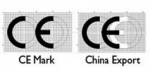
You mentioned CE. This is essentially China Export, and there is a large contingent of people who are critical of anything with the CE logo. These companies tend to cut more corners to make the items cheaper. Which is why you constantly hear people make fun of anything electrical from Harbor Freight.
View attachment 61195
The logo on the left is the European Union logo for Conformite Europeenne. The one on the right is a conveniently copied China Export logo. To complicate matters further, I've actually seen China Export logos that are absolutely identical to the European one. There is zero oversight on this in China.
When it comes to boards, there are soldering methods that are cheaper. There is the overall quality than can be compromised by vibration of the unit, or the heat of the unit, if the parts aren't made to withstand them. Even in CE products, there is a lot of planning involved in capacitor/etc layout. But how long should the thing last? Hopefully just as long as the warranty is in place. Which leads to complaints of "planned obsolescence."
If you see a pro do a teardown of an electronic and inspect the guts, you will become a believer in the planned obsolescence idea. Lower-quality plastics for the shell, sloppy machining of the metals, cheaper lubricants for moving parts. I've personally seen CE boards with fingerprints on them.
All this is why buying electronics can be so frustrating. Even if you go to websites and forums hoping to get a broad consensus, you walk away with a brain full of limp hyperbole from people who say "I will never buy Dewalt again" (after their first Dewalt purchase) or "This is a quality unit" (after using a mod for a few hours and noticing that it feels good in-hand.)
Can cheap electronics last you forever? Maybe. I've had my Harbor Freight digital caliper for over 10 years now, and the only problem is that the plastic battery compartment door broke. I've also purchased a Harbor Freight multi-tool that didn't last through a single job.
It's a crap shoot. Buy according to your expected usage level. Pay what you can afford.
Side note: For 2016 work only, my favorite companies for quality and/or customer service are all coincidentally from the U.S.
Kohler (Wisconsin)
Moen (Ohio)
VitaMix (Ohio; about 5 miles from Moen. Ha.)
Lodge (Tennessee)
McGregor Fence (Massachusetts)
U.S.A. Ohm Meters (Florida)