Introduction
I’m sure that a lot of people reading this review have heard of, or already own the Pulse AIO, it’s been pretty hard to avoid the hype behind this product.
I’m going to review the Pulse AIO from the perspective of a first time AIO user, because while I’ve used a few AIOs with rebuildable coil-heads, this is the first billet box style device that I’ve had my hands on.
More images are here
Product overview
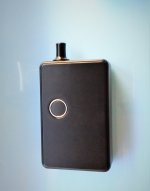
The Pulse AIO is an 80w 21700/20700/18650 AIO device, that is compatible with ‘most’ boro tanks.
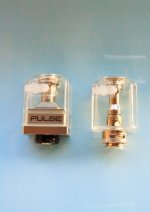
It comes with two tanks, the rebuildable Pulse Vessel RBA tank, and the Pulse Vessel VVC tank that is compatible with Vandy Vape’s range of VVC stock coils.
What do you get?
First impressions
The device itself is larger than I was expecting, similar in size to the Pulse 2 squonk mod, which makes sense as they are both single 21700 devices.
It is an all plastic device, so it lacks the solidity of an all metal AIO – but it’s light, even with a full tank and 21700 battery, it doesn’t feel overly heavy.
The general build quality looks and feels good, apart from one issue – the rear door panel has a little movement, which leads to a slight creaking sound. This seems to be caused by a gap between the panel and the tank. I partially fixed this by cutting a small piece of foam that I placed in front of the tank, however this is only a partial fix, as it reduces the movement/creaking a lot, rather than removing it totally. Some users have reported their Pulse AIO panels to be movement/creak free, so maybe it’s just mine, or maybe it’s just this color version?
Next issue for me is with the ergonomics for left-handed vapers (such as myself), when using the device in my left hand, I often found myself partially covering the airflow with the palm of my hand. This isn’t a major issue, and I found myself adjusting my hand position naturally after a short time.
Apart from the above two issues, the Pulse AIO feels nice in the hand and very similar to other Vandy Vape devices – if you like mods like the Gaur 21 and Pulse 2, you’re going to like the feel of the Pulse AIO.
Pulse AIO
The 510 pin is adjustable, to allow for certain bridges that might be a fraction shorter/taller to fit.
To secure or remove the tank, remove the drip-tip, and then unscrew the drip-tip connection which holds the tank in place.
The modes on offer are wattage, voltage, bypass, temp control and smart mode. Through various button combinations you can flip the screen, turn the screen off, lock the up/down buttons, change modes, access the functions menu and re-read the coil resistance.
The Vessel VVC tank
To be honest, this was the part of the review that motivated me the least. When I have a brand new, fancy-pants AIO in my hands, using it as a pod-mod is not high on my list of priorities. However, I assume that’s exactly how some people will be using it, so each to their own.
The Pulse AIO comes with the VVC-30 0.3ohm and VVC-60 0.6ohm coil – to remove the coil, you’re supposed to use the supplied tool, but I pulled it out with my fingers. The tank has a built in airflow ring, and a capacity of 5ml.
These coils give a very standard mesh experience, with a slightly restricted draw, I enjoyed the 0.6ohm at around 20w and the 0.6ohm at 40w.
I feel that I’m being a little unfair about these coils, there’s nothing wrong with them at all – if that’s your thing, then you’ll enjoy them – it’s just that if I wanted to vape stock-coils (or these exact stock-coils), I’d just buy a pod system for half the price.
Vessel RBA Tank
As a polar-opposite, this is the part of the review that I was looking forward to the most.
Builds
What could be improved?
The Pulse AIO doesn’t come without annoyances – but they all have solutions.
As a package, it offers very good value for money, especially when you consider that you’re getting the Vessel RBA as part of the deal, and that the Vessel RBA is quite good.
It is comparatively large when compared to other similar devices, but the trade off is that it’s 21700 compatible.
Overall, it’s a decent device and a good introduction to AIOs.
Disclaimer
The Vandy Vape Pulse AIO was provided for the purposes of this review by Sourcemore. They currently have the Pulse AIO in stock for $64.99, reduced from $94.99. However if you use the code PAIOK you can reduce the price by a further $9.00 to $56.99
I’m sure that a lot of people reading this review have heard of, or already own the Pulse AIO, it’s been pretty hard to avoid the hype behind this product.
I’m going to review the Pulse AIO from the perspective of a first time AIO user, because while I’ve used a few AIOs with rebuildable coil-heads, this is the first billet box style device that I’ve had my hands on.
More images are here
Product overview
The Pulse AIO is an 80w 21700/20700/18650 AIO device, that is compatible with ‘most’ boro tanks.
It comes with two tanks, the rebuildable Pulse Vessel RBA tank, and the Pulse Vessel VVC tank that is compatible with Vandy Vape’s range of VVC stock coils.
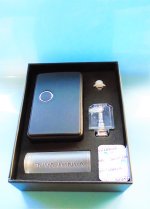
What do you get?
- Pulse AIO device
- Vessel RBA tank
- Vessel VVC tank
- 2×VVC stock coils
- 2×2.5mm 24g 0.4ohm round wire coils
- Coil cutting tool
- 18650 battery adapter
- Accessories + multi purpose tool
- Type-C USB cable
First impressions
The device itself is larger than I was expecting, similar in size to the Pulse 2 squonk mod, which makes sense as they are both single 21700 devices.
It is an all plastic device, so it lacks the solidity of an all metal AIO – but it’s light, even with a full tank and 21700 battery, it doesn’t feel overly heavy.
The general build quality looks and feels good, apart from one issue – the rear door panel has a little movement, which leads to a slight creaking sound. This seems to be caused by a gap between the panel and the tank. I partially fixed this by cutting a small piece of foam that I placed in front of the tank, however this is only a partial fix, as it reduces the movement/creaking a lot, rather than removing it totally. Some users have reported their Pulse AIO panels to be movement/creak free, so maybe it’s just mine, or maybe it’s just this color version?
Next issue for me is with the ergonomics for left-handed vapers (such as myself), when using the device in my left hand, I often found myself partially covering the airflow with the palm of my hand. This isn’t a major issue, and I found myself adjusting my hand position naturally after a short time.
Apart from the above two issues, the Pulse AIO feels nice in the hand and very similar to other Vandy Vape devices – if you like mods like the Gaur 21 and Pulse 2, you’re going to like the feel of the Pulse AIO.
Pulse AIO
- The basics:
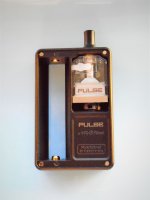
The 510 pin is adjustable, to allow for certain bridges that might be a fraction shorter/taller to fit.
To secure or remove the tank, remove the drip-tip, and then unscrew the drip-tip connection which holds the tank in place.
- The chipset:
The modes on offer are wattage, voltage, bypass, temp control and smart mode. Through various button combinations you can flip the screen, turn the screen off, lock the up/down buttons, change modes, access the functions menu and re-read the coil resistance.
- Customization:
The Vessel VVC tank
To be honest, this was the part of the review that motivated me the least. When I have a brand new, fancy-pants AIO in my hands, using it as a pod-mod is not high on my list of priorities. However, I assume that’s exactly how some people will be using it, so each to their own.
The Pulse AIO comes with the VVC-30 0.3ohm and VVC-60 0.6ohm coil – to remove the coil, you’re supposed to use the supplied tool, but I pulled it out with my fingers. The tank has a built in airflow ring, and a capacity of 5ml.
These coils give a very standard mesh experience, with a slightly restricted draw, I enjoyed the 0.6ohm at around 20w and the 0.6ohm at 40w.
I feel that I’m being a little unfair about these coils, there’s nothing wrong with them at all – if that’s your thing, then you’ll enjoy them – it’s just that if I wanted to vape stock-coils (or these exact stock-coils), I’d just buy a pod system for half the price.
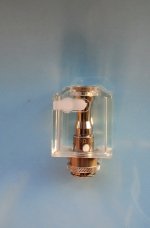
Vessel RBA Tank
As a polar-opposite, this is the part of the review that I was looking forward to the most.
- The design:
- Coiling:
- Wicking:
- The problem:
- The solution:
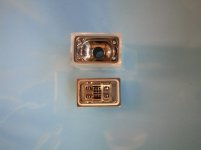
Builds
- 26g Fused Clapton 2.5mm 0.3ohms – this was a nice build, but even with the airflow fully open, it was the type of build that needed more power, but more power made it too hot. It was acceptable at 35w, but there were definitely better builds to come.
- 24g Ni80 round wire 2.5mm 0.4ohms – this was the coil that came with the kit, I usually go for 26g with round wire builds, but then again I only use round wire for MTL. Immediately, this build was an improvement – the flavor was good from 25w+ and became even better once I closed down the airflow a little.
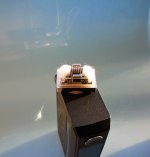
- 30g superfine MTL clapton 2.5mm 0.55ohms – for me this is my ideal build for this RBA – I put an MTL drip-tip on the AIO, closed down the airflow a lot, and from 15-20w it’s excellent. It’s not an MTL draw, more like a very restricted DL. The flavor is spot on, even with juices that struggle in a lot of RTAs. With this build, I’m more than happy to use the Pulse AIO on a daily basis.
What could be improved?
- The door panel has too much movement/creaking – if I can fix this with a piece of foam, I’m sure Vandy Vape could have come up with an easier solution.
- The drip-tip is terrible. It’s ugly, badly fitting, too short, and the bore is too wide – thankfully others do fit.
- The Vessel RBA O-ring is far too loose. It’s not a deal-breaker, but it’s annoying and requires care when removing the tank.
The Pulse AIO doesn’t come without annoyances – but they all have solutions.
As a package, it offers very good value for money, especially when you consider that you’re getting the Vessel RBA as part of the deal, and that the Vessel RBA is quite good.
It is comparatively large when compared to other similar devices, but the trade off is that it’s 21700 compatible.
Overall, it’s a decent device and a good introduction to AIOs.
Disclaimer
The Vandy Vape Pulse AIO was provided for the purposes of this review by Sourcemore. They currently have the Pulse AIO in stock for $64.99, reduced from $94.99. However if you use the code PAIOK you can reduce the price by a further $9.00 to $56.99