

Become a Patron!
You are using an out of date browser. It may not display this or other websites correctly.
You should upgrade or use an alternative browser.
You should upgrade or use an alternative browser.
The Atheists Thread...A place for Logical, Rational and Scientific thinking with facts
- Thread starter No Ash More Cash
- Start date


Hermit
Silver Contributor
Member For 4 Years
Member For 3 Years
Member For 2 Years
Member For 1 Year
Member For 5 Years
Been sober for 5yrs 1month 6 days...The only reason I remember this is...I quit xmas day 5 years ago and I just looked at the date on my PC
Plus a week! Or did it take xmas to new year to sober up?

Nice to see you came back...Been sober for 5yrs 1month 6 days...The only reason I remember this is...I quit xmas day 5 years ago and I just looked at the date on my PC
Congratulations. I'm coming up on two years in April.

I sobered up Boxing day(The day after Xmas) after I puched a cop and called him Barney fifePlus a week! Or did it take xmas to new year to sober up?
..BTW...I didn't do no jail time for that...But that's for another thread and a different day
Nice to see you came back too!Plus a week! Or did it take xmas to new year to sober up?
How did I miss this gem ... The answer is in Quantum Mechanics...And yes Subatomic Particles do appear from nothing...We still don't know how but they do...Here is a talk by Lawrence KraussThis is all the fact you need. Something can not be created from nothing. God said he always was and always will be no man will ever know how he will became. Fact one it would take something to make something. Fact two it would have to take something that has always existed to create all. Fact three try to think how that something became in existence. You can't try it you can't. You can think how anything can be made but the one and only one thing and that is the one thing God said you will never know, and that is how he became. Simple. Now if you really tried to think how he became I know what you thought and it was nothing your mind went blank. Just like God said.

Celtic Fog
Tir Na Nog
Gold Contributor
Member For 4 Years
Member For 3 Years
Member For 2 Years
Member For 1 Year
Member For 5 Years
Science is religious and Religion is a science.

... in a wacky alternate universe.
FTFY
FTFY
Science isn't religiousScience is religious and Religion is a science.
Maybe the god of String theory might show us one day... in a wacky alternate universe.
FTFY
Hmm. I think faith has a place in science in that a scientist has a degree of hope that a hypothesis will result in an empirical result. One must remember that "religion" is a process or methodology based in dogmatic principle, and is independent of faith....but when faith is APPLIED, it is through religion. The original Disciples had faith in the word of Jesus...but it's practical method did not arise until the first Sacrament known popularly as "The Last Supper" which is practiced WITH faith, and physically as the Sacrament of the Holy Eucharist. This being said, I would consider science as a practice, to be departed from religion, as there is no practical exercise of faith in scientific method. "I hope to find a cure for stupidity, NOW, lets set about to achieve this."
Hmm. I think faith has a place in science in that a scientist has a degree of hope that a hypothesis will result in an empirical result. One must remember that "religion" is a process or methodology based in dogmatic principle, and is independent of faith....but when faith is APPLIED, it is through religion. The original Disciples had faith in the word of Jesus...but it's practical method did not arise until the first Sacrament known popularly as "The Last Supper" which is practiced WITH faith, and physically as the Sacrament of the Holy Eucharist. This being said, I would consider science as a practice, to be departed from religion, as there is no practical exercise of faith in scientific method. "I hope to find a cure for stupidity, NOW, lets set about to achieve this."
http://vapingunderground.com/thread...-thinking-with-facts.49948/page-8#post-305136
http://vapingunderground.com/thread...-thinking-with-facts.49948/page-8#post-305450
http://vapingunderground.com/thread...-thinking-with-facts.49948/page-8#post-305495
Hmm. I think faith has a place in science in that a scientist has a degree of hope that a hypothesis will result in an empirical result. One must remember that "religion" is a process or methodology based in dogmatic principle, and is independent of faith....but when faith is APPLIED, it is through religion. The original Disciples had faith in the word of Jesus...but it's practical method did not arise until the first Sacrament known popularly as "The Last Supper" which is practiced WITH faith, and physically as the Sacrament of the Holy Eucharist. This being said, I would consider science as a practice, to be departed from religion, as there is no practical exercise of faith in scientific method. "I hope to find a cure for stupidity, NOW, lets set about to achieve this."
You must have missed the parts of the video where it was implied that the models were checked by the observations. Quick tip: look for the periods where certain declarative statements were countered with laughter. If the empirical data points to something else, the science must change and adapt.
A cure for stupidity? Start by looking at the stubbornness of people to harp on the same ideas and the insistence on being right in the face of better evidence to the contrary. And the unwillingness to concede simple ignorance, which, all by itself, is not a human failing, only the persistence of said ignorance.
“The World of Perception and the World of Science”
The world of perception, or in other words the world
which is revealed to us by our senses and in everyday life,
seems at first sight to be the one we know best of all. For we
need neither to measure nor to calculate in order to gain access
to this world and it would seem that we can fathom it simply
by opening our eyes and getting on with our lives. Yet this is
a delusion. In these lectures, I hope to show that the world of
perception is, to a great extent, unknown territory as long as
we remain in the practical or utilitarian attitude. I shall suggest
that much time and effort, as well as culture, have been needed
in order to lay this world bare and that one of the great
achievements of modern art and philosophy (that is, the art
and philosophy of the last fifty to seventy years) has been to
allow us to rediscover the world in which we live, yet which we
are always prone to forget.
This temptation is particularly strong in France. It is characteristic
not just of French philosophy but also of what is
rather loosely termed the French cast of mind to hold science
and knowledge in such high esteem that all our lived experience
of the world seems by contrast to be of little value. If I
want to know what light is, surely I should ask a physicist; is
it not he who can tell me what light really is? Is light, as was
once thought, a stream of burning projectiles, or, as others
have argued, vibrations in the ether? Or is it, as a more recent
theory maintains, a phenomenon that can be classed alongside
other forms of electromagnetic radiation? What good would
it do to consult our senses on this matter? Why should we
linger over what our perception tells us about colours, reflections
and the objects which bear such properties? For it seems
that these are almost certainly no more than appearances: only
the methodical investigations of a scientist – his measurements
and experiments – can set us free from the delusions of
our senses and allow us to gain access to things as they really
are. Surely the advancement of knowledge has consisted precisely
in our forgetting what our senses tell us when we consult
them naïvely. Surely there is no place for such data in a picture
of the world as it really is, except insofar as they indicate
peculiarities of our human make-up, ones which physiology
will, one day, take account of, just as it has already managed to
the world of perception explain the illusions of long- and short-
sightedness. The real world is not this world of light and colour;
it is not the fleshy spectacle which passes before my eyes. It consists,
rather, of the waves and particles which science tells us lie behind
these sensory illusions.
Descartes went as far as to say that simply by scrutinizing
sensory objects and without referring to the results of scientific
investigations, I am able to discover that my senses deceive
me and I learn accordingly to trust only my intellect.1 I claim
to see a piece of wax. Yet what exactly is this wax? It is by no
means its colour, white, nor, if it has retained this, its floral
scent, nor its softness to my touch, nor indeed the dull thud
which it makes when I drop it. Not one of these properties is
constitutive of the wax because it can lose them all without
ceasing to exist, for example if I melt it, whereupon it changes
into a colourless liquid which has no discernible scent and
which is no longer resistant to my touch. Yet I maintain that
this is still the same wax. So how should this claim be understood?
What persists through this change of state is simply a
piece of matter which has no properties, or, at most, a certain
capacity to occupy space and take on different shapes, without
either the particular space filled or the shape adopted being in
any way predetermined. This then is the real and unchanging
essence of the wax. It will be clear that the true nature of the
wax is not revealed to my senses alone, for they only ever present
me with objects of particular sizes and shapes. So I cannot
see the wax as it really is with my own eyes; the reality of the
wax can only be conceived in the intellect. When I assume I
am seeing the wax, all I am really doing is thinking back from
the properties which appear before my senses to the wax in its
naked reality, the wax which, though it lacks properties in
itself, is nonetheless the source of all the properties which
manifest themselves to me. Thus for Descartes – and this idea
has long held sway in the French philosophical tradition – perception
is no more than the confused beginnings of scientific
knowledge. The relationship between perception and scientific
knowledge is one of appearance to reality. It befits our human
dignity to entrust ourselves to the intellect, which alone can
reveal to us the reality of the world.
When I said, a moment ago, that modern art and philosophy
have rehabilitated perception and the world as we perceive
it, I did not, of course, mean to imply that they deny the value
of science, either as a means of technological advancement, or
insofar as it offers an object lesson in precision and truth. If we
wish to learn how to prove something, to conduct a thorough
investigation or to be critical of ourselves and our preconceptions,
it remains appropriate, now as then, that we turn to
science. It was a good thing that we once expected science to
the world of perception provide all the answers at a time when
it had still to come into being. The question which modern
philosophy asks in relation to science is not intended either to
contest its right to exist or to close off any particular avenue to
its inquiries. Rather, the question is whether science does, or
ever could, present us with a picture of the world which is complete,
self-sufficient and somehow closed in upon itself, such that there
could no longer be any meaningful questions outside this picture.
It is not a matter of denying or limiting the extent of scientific knowledge,
but rather of establishing whether it is entitled to deny or
rule out as illusory all forms of inquiry that do not start out
from measurements and comparisons and, by connecting particular
causes with particular consequences, end up with laws
such as those of classical physics. This question is asked not
out of hostility to science. Far from it: in fact, it is science
itself – particularly in its most recent developments – which
forces us to ask this question and which encourages us to
answer in the negative.
Since the end of the nineteenth century, scientists have got
used to the idea that their laws and theories do not provide a
perfect image of Nature but must rather be considered ever
simpler schematic representations of natural events, destined
to be honed by increasingly minute investigations; or, in other
words, these laws and theories constitute knowledge by
approximation. Science subjects the data of our experience to
a form of analysis that we can never expect will be completed
since there are no intrinsic limits to the process of observation:
we could always envisage that it might be more thorough or
more exact than it is at any given moment. The mission of science
is to undertake an interminable elucidation of the
concrete or sensible, from which it follows that the concrete or
sensible can no longer be viewed, as in the classical paradigm,
as a mere appearance destined to be surpassed by scientific
thought. The data of perception and, more generally, the
events which comprise the history of the world, cannot be
deduced from a certain number of laws which supposedly
make up the unchanging face of the universe. On the contrary,
it is the scientific law that is an approximate expression of the
physical event and which allows this event to retain its opacity.
The scientist of today, unlike his predecessor working within
the classical paradigm, no longer cherishes the illusion that he
is penetrating to the heart of things, to the object as it is in
itself. The physics of relativity confirms that absolute and
final objectivity is a mere dream by showing how each particular
observation is strictly linked to the location of the
observer and cannot be abstracted from this particular situation;
it also rejects the notion of an absolute observer. We can
no longer flatter ourselves with the idea that, in science, the
the world of perception exercise of a pure and unsituated intellect
can allow us to gain access to an object free of all human traces,
just as God would see it. This does not make the need for scientific
research any less pressing; in fact, the only thing under attack is
the dogmatism of a science that thinks itself capable of absolute and
complete knowledge. We are simply doing justice to each of
the variety of elements in human experience and, in particular,
to sensory perception.
While science and the philosophy of science have, as we
have seen, been preparing the ground for an exploration of the
world as we perceive it, painting, poetry and philosophy have
forged ahead boldly by presenting us with a very new and
characteristically contemporary vision of objects, space, animals
and even of human beings seen from the outside, just as
they appear in our perceptual field. In forthcoming lectures I
shall describe some of what we have learned in the course of
these investigations.
Maurice Merleau-Ponty
The World of Perception
Lecture 1
The world of perception, or in other words the world
which is revealed to us by our senses and in everyday life,
seems at first sight to be the one we know best of all. For we
need neither to measure nor to calculate in order to gain access
to this world and it would seem that we can fathom it simply
by opening our eyes and getting on with our lives. Yet this is
a delusion. In these lectures, I hope to show that the world of
perception is, to a great extent, unknown territory as long as
we remain in the practical or utilitarian attitude. I shall suggest
that much time and effort, as well as culture, have been needed
in order to lay this world bare and that one of the great
achievements of modern art and philosophy (that is, the art
and philosophy of the last fifty to seventy years) has been to
allow us to rediscover the world in which we live, yet which we
are always prone to forget.
This temptation is particularly strong in France. It is characteristic
not just of French philosophy but also of what is
rather loosely termed the French cast of mind to hold science
and knowledge in such high esteem that all our lived experience
of the world seems by contrast to be of little value. If I
want to know what light is, surely I should ask a physicist; is
it not he who can tell me what light really is? Is light, as was
once thought, a stream of burning projectiles, or, as others
have argued, vibrations in the ether? Or is it, as a more recent
theory maintains, a phenomenon that can be classed alongside
other forms of electromagnetic radiation? What good would
it do to consult our senses on this matter? Why should we
linger over what our perception tells us about colours, reflections
and the objects which bear such properties? For it seems
that these are almost certainly no more than appearances: only
the methodical investigations of a scientist – his measurements
and experiments – can set us free from the delusions of
our senses and allow us to gain access to things as they really
are. Surely the advancement of knowledge has consisted precisely
in our forgetting what our senses tell us when we consult
them naïvely. Surely there is no place for such data in a picture
of the world as it really is, except insofar as they indicate
peculiarities of our human make-up, ones which physiology
will, one day, take account of, just as it has already managed to
the world of perception explain the illusions of long- and short-
sightedness. The real world is not this world of light and colour;
it is not the fleshy spectacle which passes before my eyes. It consists,
rather, of the waves and particles which science tells us lie behind
these sensory illusions.
Descartes went as far as to say that simply by scrutinizing
sensory objects and without referring to the results of scientific
investigations, I am able to discover that my senses deceive
me and I learn accordingly to trust only my intellect.1 I claim
to see a piece of wax. Yet what exactly is this wax? It is by no
means its colour, white, nor, if it has retained this, its floral
scent, nor its softness to my touch, nor indeed the dull thud
which it makes when I drop it. Not one of these properties is
constitutive of the wax because it can lose them all without
ceasing to exist, for example if I melt it, whereupon it changes
into a colourless liquid which has no discernible scent and
which is no longer resistant to my touch. Yet I maintain that
this is still the same wax. So how should this claim be understood?
What persists through this change of state is simply a
piece of matter which has no properties, or, at most, a certain
capacity to occupy space and take on different shapes, without
either the particular space filled or the shape adopted being in
any way predetermined. This then is the real and unchanging
essence of the wax. It will be clear that the true nature of the
wax is not revealed to my senses alone, for they only ever present
me with objects of particular sizes and shapes. So I cannot
see the wax as it really is with my own eyes; the reality of the
wax can only be conceived in the intellect. When I assume I
am seeing the wax, all I am really doing is thinking back from
the properties which appear before my senses to the wax in its
naked reality, the wax which, though it lacks properties in
itself, is nonetheless the source of all the properties which
manifest themselves to me. Thus for Descartes – and this idea
has long held sway in the French philosophical tradition – perception
is no more than the confused beginnings of scientific
knowledge. The relationship between perception and scientific
knowledge is one of appearance to reality. It befits our human
dignity to entrust ourselves to the intellect, which alone can
reveal to us the reality of the world.
When I said, a moment ago, that modern art and philosophy
have rehabilitated perception and the world as we perceive
it, I did not, of course, mean to imply that they deny the value
of science, either as a means of technological advancement, or
insofar as it offers an object lesson in precision and truth. If we
wish to learn how to prove something, to conduct a thorough
investigation or to be critical of ourselves and our preconceptions,
it remains appropriate, now as then, that we turn to
science. It was a good thing that we once expected science to
the world of perception provide all the answers at a time when
it had still to come into being. The question which modern
philosophy asks in relation to science is not intended either to
contest its right to exist or to close off any particular avenue to
its inquiries. Rather, the question is whether science does, or
ever could, present us with a picture of the world which is complete,
self-sufficient and somehow closed in upon itself, such that there
could no longer be any meaningful questions outside this picture.
It is not a matter of denying or limiting the extent of scientific knowledge,
but rather of establishing whether it is entitled to deny or
rule out as illusory all forms of inquiry that do not start out
from measurements and comparisons and, by connecting particular
causes with particular consequences, end up with laws
such as those of classical physics. This question is asked not
out of hostility to science. Far from it: in fact, it is science
itself – particularly in its most recent developments – which
forces us to ask this question and which encourages us to
answer in the negative.
Since the end of the nineteenth century, scientists have got
used to the idea that their laws and theories do not provide a
perfect image of Nature but must rather be considered ever
simpler schematic representations of natural events, destined
to be honed by increasingly minute investigations; or, in other
words, these laws and theories constitute knowledge by
approximation. Science subjects the data of our experience to
a form of analysis that we can never expect will be completed
since there are no intrinsic limits to the process of observation:
we could always envisage that it might be more thorough or
more exact than it is at any given moment. The mission of science
is to undertake an interminable elucidation of the
concrete or sensible, from which it follows that the concrete or
sensible can no longer be viewed, as in the classical paradigm,
as a mere appearance destined to be surpassed by scientific
thought. The data of perception and, more generally, the
events which comprise the history of the world, cannot be
deduced from a certain number of laws which supposedly
make up the unchanging face of the universe. On the contrary,
it is the scientific law that is an approximate expression of the
physical event and which allows this event to retain its opacity.
The scientist of today, unlike his predecessor working within
the classical paradigm, no longer cherishes the illusion that he
is penetrating to the heart of things, to the object as it is in
itself. The physics of relativity confirms that absolute and
final objectivity is a mere dream by showing how each particular
observation is strictly linked to the location of the
observer and cannot be abstracted from this particular situation;
it also rejects the notion of an absolute observer. We can
no longer flatter ourselves with the idea that, in science, the
the world of perception exercise of a pure and unsituated intellect
can allow us to gain access to an object free of all human traces,
just as God would see it. This does not make the need for scientific
research any less pressing; in fact, the only thing under attack is
the dogmatism of a science that thinks itself capable of absolute and
complete knowledge. We are simply doing justice to each of
the variety of elements in human experience and, in particular,
to sensory perception.
While science and the philosophy of science have, as we
have seen, been preparing the ground for an exploration of the
world as we perceive it, painting, poetry and philosophy have
forged ahead boldly by presenting us with a very new and
characteristically contemporary vision of objects, space, animals
and even of human beings seen from the outside, just as
they appear in our perceptual field. In forthcoming lectures I
shall describe some of what we have learned in the course of
these investigations.
Maurice Merleau-Ponty
The World of Perception
Lecture 1
Last edited:

Adrienne
Silver Contributor
Member For 4 Years
Member For 3 Years
Member For 2 Years
Member For 1 Year
Member For 5 Years
...To the magpies I have never seen one in the US but they are all over the place in the UK... When I was a kid I remember Some people go looking for their nests due to the birds well know trate that they collect shiny objects and apparently you can find jewelry in the nests but I think that got debunked not so long ago...
Yeah, I'm a giant Anglophile, so I choose the ubiquitous European Magpie amongst them, but really the whole family Corvidae are a bunch of stunners. Loads to read and watch about them on the internet, and it's honestly some good stuff. A nice recentish article added to the heap - http://www.economist.com/blogs/babbage/2014/04/corvid-behaviour, and a YT example of the article's content -
You'll notice that the YT comments about that video quickly turn to the main thrust of this thread.
Magpies are one of a select few species (us, some apes, dolphins, elephants) who pass the mirror test for self-awareness. Plus, they're just droll, mischievous little guys
 .
.
We've got magpies all over, here. They're cute, if a little noisy in the morning. The other corvids, the crows, well, they're bastards if you so much as look at them.
Adrienne
Silver Contributor
Member For 4 Years
Member For 3 Years
Member For 2 Years
Member For 1 Year
Member For 5 Years
We've got magpies all over, here. They're cute, if a little noisy in the morning. The other corvids, the crows, well, they're bastards if you so much as look at them.
Hey! Watch it, cave boy. Ragging on all those cool corvids... You'd best mind your nuts around all those Canadian crows.
(Okay, okay...I'll knock it off, Ash. Straggling way off topic as per usual...)
Hey! Watch it, cave boy. Ragging on all those cool corvids... You'd best mind your nuts around all those Canadian crows.
Ouch! I'll never go outside again ...

Anus Braun
Bronze Contributor
Bronze Contributor
Member For 4 Years
Member For 3 Years
Member For 2 Years
If it does (anygiventhang...) exist, a human, or possibly an extra-terrestrial has SEEN it, measured it..somewhere, at some time....I'm from the SHOW ME state...iiiiaaahhh, iiiiaaahhhh...ctulhu ftagn !This Thread isn't meant to bash or offend Religions, Religious People or People who believe in the Supernatural,Astrology or superstitions and other things that can't be proven so please show respect to others who do believe in them here....In other words..TALK ABOUT THE IDEOLOGY AND NOT THE "INDIVIDUAL" HERE but this is a place where people who don't believe in such illogical, unproven, irrational things... This is a place to hang out to discus and post things that interest you and that you would like to share with fact's with others with similar thoughts or outlooks on life ie..Science, Politics, Views or just how the world is to you
So with that said I'll start off with something that got me started on my road to Logical, Rational and Scientific thinking and always seeking the truth
I found this some time ago on YT but knew about the facts since High School in Religious Studies
This is all based on Proven Facts of the History of Ancient Astrology, Superstitions and the believes of early man that has brought religion to what is it today
“We are all atheists about most of the gods that humanity has ever believed in. Some of us just go one god further.”
― Richard Dawkins, The God Delusion
Also this by Richard Dawkins
Last edited:
"Anus" Braun? Are you a Comcast customer?
Anus Braun
Bronze Contributor
Bronze Contributor
Member For 4 Years
Member For 3 Years
Member For 2 Years
Nah, I get broadcast only...getting to be more selections, at least why youse axe ?"Anus" Braun? Are you a Comcast customer?
Anus Braun
Bronze Contributor
Bronze Contributor
Member For 4 Years
Member For 3 Years
Member For 2 Years
Parents named 'Colon', and 'Rectum', I'd suppose !and who would name their kid "anus"? some asshole?

kelli
Vapid Vapetress
Platinum Contributor
Member For 4 Years
Member For 3 Years
Member For 2 Years
Member For 1 Year
Member For 5 Years
Parents named 'Colon', and 'Rectum', I'd suppose !
oh, you mean like oral roberts. his brother is nasal, his sister is vaginal, his mom and dad are anal and scrotal.
Anus Braun
Bronze Contributor
Bronze Contributor
Member For 4 Years
Member For 3 Years
Member For 2 Years
I have a few distant cousins, attended that University...oh, you mean like oral roberts. his brother is nasal, his sister is vaginal, his mom and dad are anal and scrotal.
Nah, I get broadcast only...getting to be more selections, at least why youse axe ?
http://www.foxnews.com/us/2015/02/07/comcast-changes-name-on-another-customer-bill-to-profanity/
http://vapingunderground.com/threads/lol-comcast.53716/
Anus Braun
Bronze Contributor
Bronze Contributor
Member For 4 Years
Member For 3 Years
Member For 2 Years
That's funny shit ! Hadn't heard, I DID however, hear of some bureaucrat NAMING somebody 'Anus Brown', long-time back...Struck me as super-humorous...NOW, if I were a female, I might've picked the username 'Vagina Redd', or summat...(my old username was getting old, boring, but accurate to one of my main things...sharpening. I wanted something funny, yet 'clinical', as opposed to 'out-right foul'.)
Last edited:
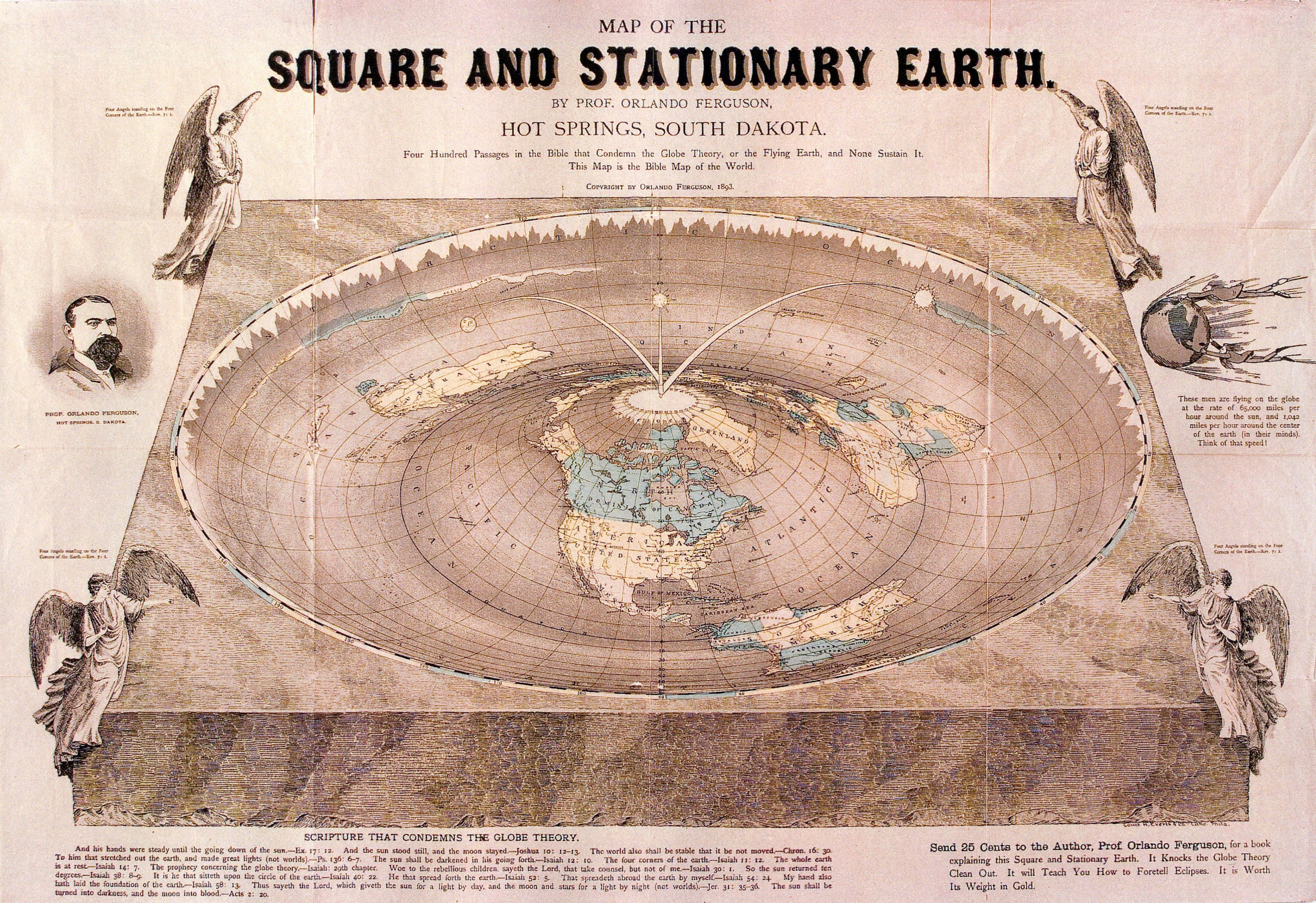
Great news! After a troubled recent history, The Flat Earth Society has decided to resume official acceptance of new members.
History of the Flat Earth Society
The modern age of the Flat Earth Society dates back to the early 1800s, when it was founded by Samuel Birley Rowbotham, an English inventor. Samuel Rowbotham's Flat Earth views were based largely on literal interpretation of Bible passages. His system, called Zetetic Astronomy, held that the earth is a flat disk centered at the North Pole and bounded along its 'southern' edge by a wall of ice, with the sun, moon, planets, and stars only a few hundred miles above the surface of the earth. After Rowbotham's death in 1884, followers of his Zetetic Astronomy founded the Universal Zetetic Society.
Flat Earth theory spread to the United States, largely in the town of Zion, Illinois where Christian Catholic Apostolic Church founder John Alexander Dowie and later Wilbur Glenn Voliva promoted Flat Earth theory. Voliva died in 1942 and the church quickly disintegrated. Flat Earthism remained in Zion, gradually becoming less popular into the 1950s.
The International Flat Earth Society was formally founded in 1956 by Samuel Shenton, a Fellow of the Royal Astronomical Society and the Royal Geographic Society. Shenton died in 1971 and Charles K. Johnson became president of the International Flat Earth Society. Johnson actively and charistmatically promoted the Society and, over time, its membership increased to over 3,000. His wife Marjory took an active role in the Society as well, often contributing articles to the Flat Earth Society Newsletter.
In 1995, a fire destroyed the Johnson's home as well as all of the Flat Earth Society's library, archives and membership lists. Following a long period of poor health, Charles K. Johnson's wife Marjory Johnson passed away in 1996. He vowed to rebuild the society. Sadly, Charles K. Johnson passed away in 2001 at the age of 76, leaving the Society's future uncertain.
After several years of inactivity, the Flat Earth Society was resurrected in 2004 and remains active today at theflatearthsociety.org. The Society officially reopened to new members on 30th October 2009.
http://www.theflatearthsociety.org
After a troubled recent history, The Flat Earth Society has decided to resume official acceptance of new members.
History of the Flat Earth Society
The modern age of the Flat Earth Society dates back to the early 1800s, when it was founded by Samuel Birley Rowbotham, an English inventor. Samuel Rowbotham's Flat Earth views were based largely on literal interpretation of Bible passages. His system, called Zetetic Astronomy, held that the earth is a flat disk centered at the North Pole and bounded along its 'southern' edge by a wall of ice, with the sun, moon, planets, and stars only a few hundred miles above the surface of the earth. After Rowbotham's death in 1884, followers of his Zetetic Astronomy founded the Universal Zetetic Society.
Flat Earth theory spread to the United States, largely in the town of Zion, Illinois where Christian Catholic Apostolic Church founder John Alexander Dowie and later Wilbur Glenn Voliva promoted Flat Earth theory. Voliva died in 1942 and the church quickly disintegrated. Flat Earthism remained in Zion, gradually becoming less popular into the 1950s.
The International Flat Earth Society was formally founded in 1956 by Samuel Shenton, a Fellow of the Royal Astronomical Society and the Royal Geographic Society. Shenton died in 1971 and Charles K. Johnson became president of the International Flat Earth Society. Johnson actively and charistmatically promoted the Society and, over time, its membership increased to over 3,000. His wife Marjory took an active role in the Society as well, often contributing articles to the Flat Earth Society Newsletter.
In 1995, a fire destroyed the Johnson's home as well as all of the Flat Earth Society's library, archives and membership lists. Following a long period of poor health, Charles K. Johnson's wife Marjory Johnson passed away in 1996. He vowed to rebuild the society. Sadly, Charles K. Johnson passed away in 2001 at the age of 76, leaving the Society's future uncertain.
After several years of inactivity, the Flat Earth Society was resurrected in 2004 and remains active today at theflatearthsociety.org. The Society officially reopened to new members on 30th October 2009.
http://www.theflatearthsociety.org
Last edited:
Great news!
History of the Flat Earth Society
The modern age of the Flat Earth Society dates back to the early 1800s, when it was founded by Samuel Birley Rowbotham, an English inventor. Samuel Rowbotham's Flat Earth views were based largely on literal interpretation of Bible passages. His system, called Zetetic Astronomy, held that the earth is a flat disk centered at the North Pole and bounded along its 'southern' edge by a wall of ice, with the sun, moon, planets, and stars only a few hundred miles above the surface of the earth. After Rowbotham's death in 1884, followers of his Zetetic Astronomy founded the Universal Zetetic Society.
Flat Earth theory spread to the United States, largely in the town of Zion, Illinois where Christian Catholic Apostolic Church founder John Alexander Dowie and later Wilbur Glenn Voliva promoted Flat Earth theory. Voliva died in 1942 and the church quickly disintegrated. Flat Earthism remained in Zion, gradually becoming less popular into the 1950s.
The International Flat Earth Society was formally founded in 1956 by Samuel Shenton, a Fellow of the Royal Astronomical Society and the Royal Geographic Society. Shenton died in 1971 and Charles K. Johnson became president of the International Flat Earth Society. Johnson actively and charistmatically promoted the Society and, over time, its membership increased to over 3,000. His wife Marjory took an active role in the Society as well, often contributing articles to the Flat Earth Society Newsletter.
In 1995, a fire destroyed the Johnson's home as well as all of the Flat Earth Society's library, archives and membership lists. Following a long period of poor health, Charles K. Johnson's wife Marjory Johnson passed away in 1996. He vowed to rebuild the society. Sadly, Charles K. Johnson passed away in 2001 at the age of 76, leaving the Society's future uncertain.
After several years of inactivity, the Flat Earth Society was resurrected in 2004 and remains active today at theflatearthsociety.org. The Society officially reopened to new members on 30th October 2009.
http://www.theflatearthsociety.org
I remember seeing one of their newsletters from the 1980s. The front page reported on their annual gathering on the shores of the Salton Sea. The group would split with some going to the opposite side. From there they would observe each other through telescopes across the sea. Thus demonstrating once again that the earth is flat.
Seemed like quite the merry backward lot.
I knew that about the Crows but I didn't know that about magpies...I knew a few animals that you listed but the magpie is news to me...Cheers!Yeah, I'm a giant Anglophile, so I choose the ubiquitous European Magpie amongst them, but really the whole family Corvidae are a bunch of stunners. Loads to read and watch about them on the internet, and it's honestly some good stuff. A nice recentish article added to the heap - http://www.economist.com/blogs/babbage/2014/04/corvid-behaviour, and a YT example of the article's content -
You'll notice that the YT comments about that video quickly turn to the main thrust of this thread.
Magpies are one of a select few species (us, some apes, dolphins, elephants) who pass the mirror test for self-awareness. Plus, they're just droll, mischievous little guys.
Crazy bastards!!!Great news!
History of the Flat Earth Society
The modern age of the Flat Earth Society dates back to the early 1800s, when it was founded by Samuel Birley Rowbotham, an English inventor. Samuel Rowbotham's Flat Earth views were based largely on literal interpretation of Bible passages. His system, called Zetetic Astronomy, held that the earth is a flat disk centered at the North Pole and bounded along its 'southern' edge by a wall of ice, with the sun, moon, planets, and stars only a few hundred miles above the surface of the earth. After Rowbotham's death in 1884, followers of his Zetetic Astronomy founded the Universal Zetetic Society.
Flat Earth theory spread to the United States, largely in the town of Zion, Illinois where Christian Catholic Apostolic Church founder John Alexander Dowie and later Wilbur Glenn Voliva promoted Flat Earth theory. Voliva died in 1942 and the church quickly disintegrated. Flat Earthism remained in Zion, gradually becoming less popular into the 1950s.
The International Flat Earth Society was formally founded in 1956 by Samuel Shenton, a Fellow of the Royal Astronomical Society and the Royal Geographic Society. Shenton died in 1971 and Charles K. Johnson became president of the International Flat Earth Society. Johnson actively and charistmatically promoted the Society and, over time, its membership increased to over 3,000. His wife Marjory took an active role in the Society as well, often contributing articles to the Flat Earth Society Newsletter.
In 1995, a fire destroyed the Johnson's home as well as all of the Flat Earth Society's library, archives and membership lists. Following a long period of poor health, Charles K. Johnson's wife Marjory Johnson passed away in 1996. He vowed to rebuild the society. Sadly, Charles K. Johnson passed away in 2001 at the age of 76, leaving the Society's future uncertain.
After several years of inactivity, the Flat Earth Society was resurrected in 2004 and remains active today at theflatearthsociety.org. The Society officially reopened to new members on 30th October 2009.
http://www.theflatearthsociety.org
I hope they got betterI have a few distant cousins, attended that University...
Climate Scientist Wins $50,000 In Libel Lawsuit Against Conservative Newspaper
http://thinkprogress.org/climate/2015/02/09/3621026/always-read-the-comments/
http://thinkprogress.org/climate/2015/02/09/3621026/always-read-the-comments/
^^^^^ multi-like ^^^^^

Midniteoyl
Gold Contributor
Member For 4 Years
Member For 3 Years
Member For 2 Years
Member For 1 Year
Member For 5 Years
Ya.. be skeptical, be pro-for, but at least get facts right.. LOL
Ya.. be skeptical, be pro-for, but at least get facts right.. LOL
You said it, brother. Acknowledge the facts and then get on with the much more difficult problem (politically) of reconciling the facts with our common values and priorities.
Talk about minority public expression, this modest effort is laudable but all in all pretty damn sad. Registers about as impactful as a door stop to the courthouse, yet still is perceived as an object of derision and therefore becomes an object of derision. Oy.


http://www.patheos.com/blogs/friend...f-florida-courthouse-and-announces-many-more/
http://www.patheos.com/blogs/friend...f-florida-courthouse-and-announces-many-more/
Last edited:
Pfft. I like it.
http://www.patheos.com/blogs/friend...f-florida-courthouse-and-announces-many-more/
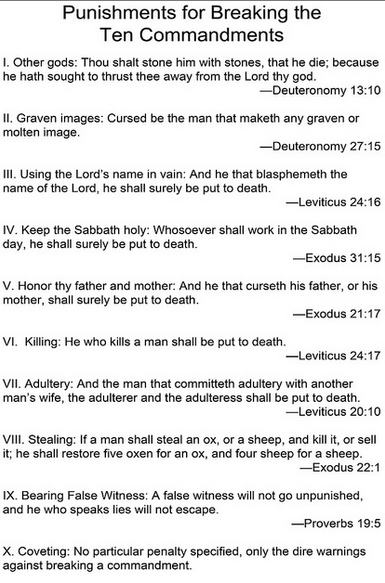
It kind of puts the whole 10 commandments thing into proper perspective, doesn't it?
Well, I mean, apart from not mentioning the other 603 commandments (Exodus, Leviticus, Numbers, and Deuteronomy) ....
http://www.jewfaq.org/613.htm
Patheos said:In May of 2012, Community Men’s Fellowship (a Christian group) gave the city of Bradford County, Florida the “gift” of a $22,000 Ten Commandments monument to put outside the county courthouse:
At the time, American Atheists and plaintiff Daniel Cooney filed a lawsuit against the county. County officials were ready to take down the monument… but the Community Men’s Fellowship refused to remove it. In fact, God told them not to:
… Community Men’s Fellowship wrote back: “We have prayerfully considered your request and have determined that we will not comply with the County’s order.”
So they broke the law, but had no intention of fixing the situation.
So what could the city do? They could have hired people to lug that giant thing away (though I don’t know why they should’ve had to pay for that) or they could’ve sued the Christian group (again, who would pay for it?)… after weighing their options, and having a meeting with both sides, city officials decided to make the courthouse area a free-for-all. Anyone who wanted a monument would be allowed to have one.
Fine, said American Atheists. We’ll call your bluff and put up our own monument!
http://www.patheos.com/blogs/friend...f-florida-courthouse-and-announces-many-more/
It kind of puts the whole 10 commandments thing into proper perspective, doesn't it?
Well, I mean, apart from not mentioning the other 603 commandments (Exodus, Leviticus, Numbers, and Deuteronomy) ....
http://www.jewfaq.org/613.htm
Mean ol' Yahweh is an easy mark. I prefer this side:
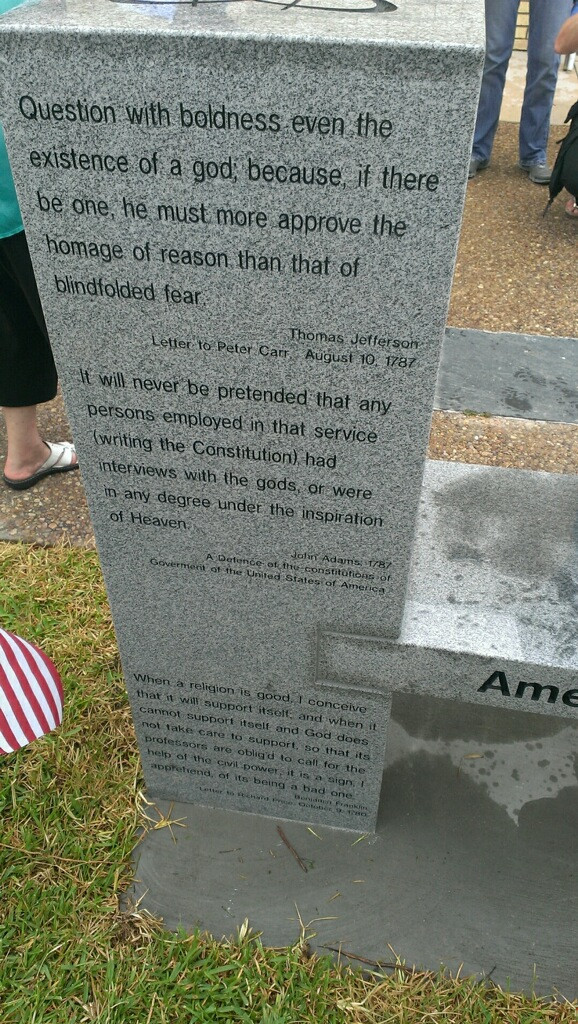
Love John Adams' wit: It will never be pretended that there were "interviews with the gods" in the writing of the constitution.
Love John Adams' wit: It will never be pretended that there were "interviews with the gods" in the writing of the constitution.
Last edited:
Huh?
Here's the constitution. Where's the evidence of interviews with the gods?
http://www.archives.gov/exhibits/charters/constitution_transcript.html
http://www.usconstitution.net/consttop_reli.html
Here's the constitution. Where's the evidence of interviews with the gods?
http://www.archives.gov/exhibits/charters/constitution_transcript.html
u.s. constitution said:God
It has often been seen on the Internet that to find God in the Constitution, all one has to do is read it, and see how often the Framers used the words "God," or "Creator," "Jesus," or "Lord." Except for one notable instance, however, none of these words ever appears in the Constitution, neither the original nor in any of the Amendments. The notable exception is found in the Signatory section, where the date is written thusly: "Seventeenth Day of September in the Year of our Lord one thousand seven hundred and Eighty seven". The use of the word "Lord" here is not a religious reference, however. This was a common way of expressing the date, in both religious and secular contexts. This lack of any these words does not mean that the Framers were not spiritual people, any more than the use of the word Lord means that they were. What this lack of these words is expositive of is not a love for or disdain for religion, but the feeling that the new government should not involve itself in matters of religion. In fact, the original Constitution bars any religious test to hold any federal office in the United States. For more information, see the Religion Topic Page.
http://www.usconstitution.net/consttop_reli.html
Huh?
Here's the constitution. Where's the evidence of interviews with the gods?
http://www.archives.gov/exhibits/charters/constitution_transcript.html
http://www.usconstitution.net/consttop_reli.html
There isn't. Reread Adams' quote. I also like that he chose to say "gods" not God.
Well, John Adams' quote I agree with.
I should hope so!

Great news!
History of the Flat Earth Society
The modern age of the Flat Earth Society dates back to the early 1800s, when it was founded by Samuel Birley Rowbotham, an English inventor. Samuel Rowbotham's Flat Earth views were based largely on literal interpretation of Bible passages. His system, called Zetetic Astronomy, held that the earth is a flat disk centered at the North Pole and bounded along its 'southern' edge by a wall of ice, with the sun, moon, planets, and stars only a few hundred miles above the surface of the earth. After Rowbotham's death in 1884, followers of his Zetetic Astronomy founded the Universal Zetetic Society.
Flat Earth theory spread to the United States, largely in the town of Zion, Illinois where Christian Catholic Apostolic Church founder John Alexander Dowie and later Wilbur Glenn Voliva promoted Flat Earth theory. Voliva died in 1942 and the church quickly disintegrated. Flat Earthism remained in Zion, gradually becoming less popular into the 1950s.
The International Flat Earth Society was formally founded in 1956 by Samuel Shenton, a Fellow of the Royal Astronomical Society and the Royal Geographic Society. Shenton died in 1971 and Charles K. Johnson became president of the International Flat Earth Society. Johnson actively and charistmatically promoted the Society and, over time, its membership increased to over 3,000. His wife Marjory took an active role in the Society as well, often contributing articles to the Flat Earth Society Newsletter.
In 1995, a fire destroyed the Johnson's home as well as all of the Flat Earth Society's library, archives and membership lists. Following a long period of poor health, Charles K. Johnson's wife Marjory Johnson passed away in 1996. He vowed to rebuild the society. Sadly, Charles K. Johnson passed away in 2001 at the age of 76, leaving the Society's future uncertain.
After several years of inactivity, the Flat Earth Society was resurrected in 2004 and remains active today at theflatearthsociety.org. The Society officially reopened to new members on 30th October 2009.
http://www.theflatearthsociety.org
Wait... these people still exist? And... after a quick scan of their wiki, cite Pythagoras even though Pathagoras was the one who calculated the diameter of the Earth using the shadow of the sun on a well shaft? Wow... they do indeed still exist.

anendeloflorien
Silver Contributor
Member For 4 Years
Member For 3 Years
Member For 2 Years
Member For 1 Year
Member For 5 Years
I'm just going to leave this here....... Don't let the title throw you. I don't want to say too much because it's one of those videos you just have to watch and think about to understand.
Wait... these people still exist? And... after a quick scan of their wiki, cite Pythagoras even though Pathagoras was the one who calculated the diameter of the Earth using the shadow of the sun on a well shaft? Wow... they do indeed still exist.
Um, Eratosthenes calculated the circumference of the earth. Pythagoras was a philosopher and not even responsible for the mathematical theorem that bears his name.